

Roughly one in three teens report feeling anxious about appearing on camera during online meetings. For those seeking mental health support, this worry can make virtual IOP seem out of reach. Many teens believe virtual IOP requires constant video—that they'll be forced to appear on screen during every group therapy session, every individual therapy appointment, every family session. The truth is simpler: most virtual IOP programs allow teens to participate with their camera off, and many have built-in accommodations specifically for this barrier.
If your teen has camera anxiety, they can still attend virtual IOP. The question isn't whether it's possible—it's which program offers the flexibility your teen needs, and how to set expectations before starting.
Can My Teen Do Virtual IOP If They Have Camera Anxiety?
Yes. Virtual IOP programs designed for teens understand that camera anxiety is a legitimate barrier to engagement. Most programs allow audio-only participation during group therapy and individual therapy sessions. Your teen can join the call, hear the therapist and peers, speak when they want to contribute, and keep their camera off the entire time.
Some virtual IOP programs go further. They may ask that teens turn their camera on for the first few minutes of a session to confirm identity, then allow it off for the rest. Others never require video at all. A few programs ask that cameras stay on during family therapy sessions—since family involvement is a core part of treatment—but allow audio-only during group work.
The key is asking the program directly about their camera policy before enrollment. Don't assume. Call and ask: "Can my teen participate with their camera off during group therapy? During individual sessions? Are there any sessions where video is required?" A good virtual IOP program will have a clear answer and won't make your teen feel ashamed for asking.
What Is Virtual IOP?
Virtual intensive outpatient program (virtual IOP) is a structured mental health treatment delivered online. It sits between weekly therapy and more intensive care. Your teen attends multiple therapy sessions each week—usually three to five—while continuing to live at home and attend school.
Virtual IOP provides more support than weekly therapy but less intensity than partial hospitalization (PHP) or residential treatment. It's designed for teens dealing with depression, anxiety, eating disorders, substance abuse, bipolar disorder, obsessive-compulsive disorder, and other mental health challenges that need more than an hour a week to address.
A typical virtual intensive outpatient program includes group therapy, individual therapy sessions, family therapy, and medication management when needed. Sessions are scheduled on specific days and times each week. Your teen logs in from home, connects with a therapist and peers, and works on coping skills, emotional regulation, and treatment goals in real time.
What Accommodations Do Virtual IOPs Offer for Camera-Shy Teens?
The best virtual IOP programs for teens recognize that camera anxiety is a health barrier, not a character flaw. Here's what to look for:
- Audio-only participation during group therapy and individual therapy sessions
- No camera requirement for any session, or camera-on only for identity verification at session start
- Clear written policy on camera expectations before your teen enrolls
- Therapist willingness to discuss camera anxiety as part of treatment (not as a reason to exclude your teen)
- Scheduled breaks during longer sessions so your teen can step away if they feel overwhelmed
- Private space requirement (not a public room) so your teen feels safe regardless of camera status
Some programs also offer a trial session or a brief call with the clinical team before starting, so your teen can ask questions and get a sense of the environment without committing. This can reduce anxiety about the unknown.
Can Teens Participate in Virtual IOP Groups Without Video?
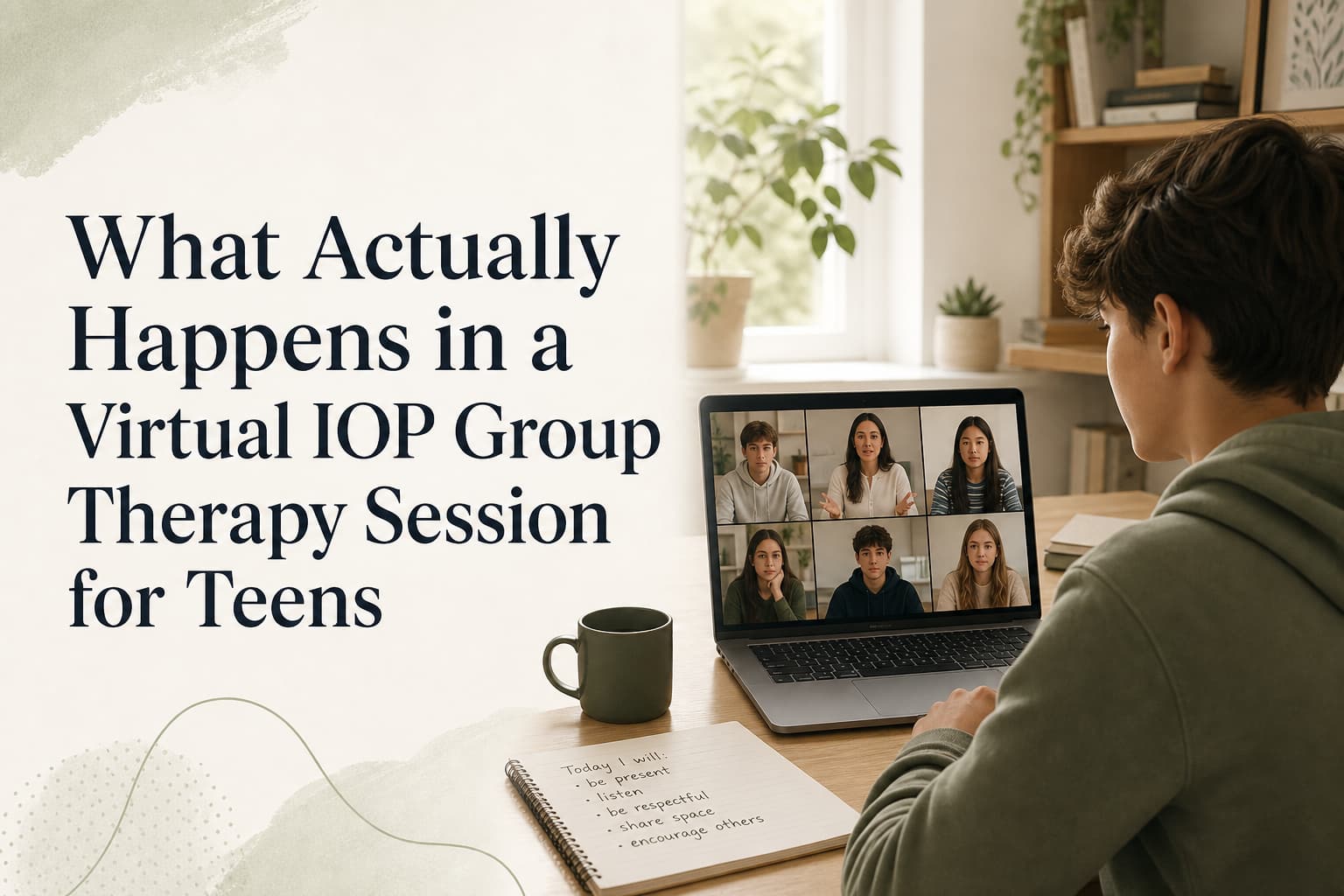
Yes. Group therapy is a core part of virtual IOP for teens. In a typical group, your teen connects with five to ten other young adults working on similar issues. A therapist or two guides the session, and peers share experiences and support each other.
Most programs allow audio-only participation in group therapy. Your teen can listen, speak, and engage fully without turning on their camera. They'll hear other group members' voices, feel part of the conversation, and benefit from peer connection—one of the most powerful parts of group work.
Some teens find that audio-only participation actually helps them focus. Without the distraction of seeing themselves on screen or worrying about how they look, they can concentrate on what's being said and what they want to contribute. Over time, as anxiety decreases and trust builds, some teens choose to turn their camera on. Others don't, and that's fine.
What About Individual Therapy Sessions?
Individual therapy sessions are typically one-on-one between your teen and their assigned therapist. Most virtual IOP programs allow audio-only participation here too. Your teen meets with their therapist weekly or more often, depending on the program structure.
In individual therapy, your teen works on specific treatment goals—managing anxiety, processing trauma, building coping skills, or addressing depression. The therapist might use cognitive behavioral therapy (CBT), dialectical behavior therapy (DBT), or other evidence-based approaches. Camera anxiety shouldn't prevent this work.
Some therapists prefer to see your teen's face to pick up on nonverbal cues. If your teen's assigned therapist feels strongly about this, it's worth a conversation. Often, a therapist will agree to audio-only for the first few sessions while your teen builds comfort, then revisit the question later. The goal is engagement, not compliance.
How Do Virtual IOPs Handle Family Therapy?
Family therapy is a standard part of virtual IOP for teens. Family involvement in treatment improves outcomes. These sessions typically include your teen, one or both parents, and sometimes siblings—all on the same video call with a therapist.
Some programs require cameras on during family sessions because the therapist needs to see facial expressions and body language to guide the conversation. Others allow audio-only for your teen while parents are on video. A few programs are flexible across the board.
If your teen has severe camera anxiety, ask whether family sessions can happen with your teen's camera off. Many therapists can work effectively this way. The focus is on communication and connection, not on whether everyone's face is visible. If a program refuses to accommodate this, it may not be the right fit for your teen.
What Are the Technical Requirements for Virtual IOP?
Virtual IOP requires a stable internet connection, a computer or tablet with a microphone, and a private space where your teen can talk without interruption. A camera is standard equipment, but as discussed, it doesn't always need to be on.
The private space is important. Your teen needs a room where they can speak openly without siblings, parents, or roommates overhearing. This might be their bedroom, a quiet corner of the house, or even a parked car if home isn't an option. The point is privacy and minimal distractions.
Virtual IOP programs use secure, HIPAA-compliant platforms to protect your teen's privacy and health information. These platforms are encrypted and designed specifically for mental health care. Your teen's sessions are confidential.
Is Virtual IOP as Effective as In-Person IOP?
Research has shown that young people can feel very satisfied with online therapy formats. Virtual therapy can be just as effective as in-person care for many teens, especially when the program is well-designed and the therapist is skilled at working online.
Virtual IOP may actually be a stronger fit for some teens. If transportation is difficult, if your teen feels more comfortable engaging from home, or if scheduling makes in-person attendance impossible, virtual removes those barriers. A teen who can't get to an office three times a week can access treatment from their bedroom.
In-person IOP may be a better option when a teen struggles with focus at home or benefits more from face-to-face interaction. Some teens do better in a physical space with other people present. The choice depends on your teen's needs, not on a blanket rule.
What Mental Health Challenges Does Virtual IOP Treat?
Virtual IOP for teens addresses depression, anxiety, eating disorders, substance abuse, bipolar disorder, obsessive-compulsive disorder, and trauma-related conditions. These programs are built to help teens manage the mental health challenges that interfere with daily life, school, and relationships.
The program is designed for teens and young adults who need more support than weekly therapy but don't require 24-hour care. If your teen is in active crisis—having suicidal thoughts, in acute withdrawal, or unable to care for themselves, virtual IOP is not appropriate. In those cases, a higher level of care like partial hospitalization (PHP) or residential treatment is needed.
For most other mental health challenges, virtual IOP can be an effective treatment option. The key is matching the right program to your teen's specific needs and comfort level.
What Therapeutic Approaches Are Used in Virtual IOP?
Virtual IOP programs typically use evidence-based therapy methods. Cognitive behavioral therapy (CBT) helps teens identify thought patterns that fuel anxiety or depression and practice new ways of thinking. Dialectical behavior therapy (DBT) teaches emotional regulation, distress tolerance, and interpersonal skills, especially helpful for teens with intense emotions or self-harm urges.
For teens with obsessive-compulsive disorder, programs may use exposure and response prevention (ERP), which gradually reduces the anxiety that fuels compulsions. Family therapy addresses communication patterns and helps parents support their teen's recovery. Medication management, when needed, is coordinated with a psychiatrist or psychiatric nurse practitioner.
The specific approach depends on your teen's diagnosis and the program's model. Ask what therapeutic methods the program uses and whether they match your teen's needs.
How Often Do Teens Attend Virtual IOP Sessions?
Virtual IOP intensity varies by program. Most programs meet three to five times per week, with sessions lasting two to four hours. Your teen might attend group therapy on Monday and Wednesday evenings, individual therapy on Tuesday, and family therapy on Thursday.
Longer virtual IOP sessions have scheduled breaks, and teens can talk to therapists if they need additional breaks. This structure allows your teen to work on significant issues without the full-time commitment of residential treatment or partial hospitalization.
The schedule is designed to allow teens to continue attending school and maintaining daily routines. Virtual IOP provides intensive support while allowing teens to stay connected to their home, family, and education.
What Should Your Teen Expect in Their First Virtual IOP Session?
Your teen's first session usually starts with a brief orientation. The therapist explains how the platform works, where to log in, and what to expect. If your teen has camera anxiety, this is the time to mention it. A good program will normalize the question and explain their policy clearly.
In the first group session, your teen will meet their therapist and group members. Introductions are common, each person shares a bit about themselves and why they're there. Your teen can participate as much or as little as they're comfortable with. No one is forced to share on day one.
Individual therapy sessions start with the therapist asking about your teen's background, current challenges, and treatment goals. This is an information-gathering session. Your teen doesn't need to have everything figured out, the therapist will help.
Family therapy usually happens after your teen has had a few individual sessions. The therapist will explain the purpose and ask your family what you hope to get out of treatment. This is collaborative work, not blame or judgment.
When Is Virtual IOP Not the Right Choice?
Virtual IOP is not appropriate for teens in active crisis. If your teen is actively suicidal, in acute substance withdrawal, unable to care for themselves, or experiencing severe psychosis, they need a higher level of care immediately. Partial hospitalization (PHP) or residential treatment provides more intensive monitoring and support.
Virtual IOP also may not work if your teen has no stable internet connection, no private space, or severe difficulty with self-regulation at home. Some teens do better with the structure and supervision of in-person programs. That's not a failure, it's a match issue.
If your teen has tried virtual IOP and it's not working after a fair trial (usually 2–3 weeks), talk to the clinical team about alternatives. In-person IOP, PHP, or a different virtual program might be a better fit.
How to Choose a Virtual IOP Program That Accommodates Camera Anxiety
When you're researching virtual IOP programs for your teen, ask these specific questions: What is your camera policy? Can teens participate with their camera off during group therapy? During individual sessions? Are there any sessions where video is required? How do you handle teens with camera anxiety?
Look for programs that treat camera anxiety as a legitimate barrier, not a character flaw. If a program seems dismissive or inflexible, keep looking. The right program will have clear policies, will explain accommodations upfront, and will work with your teen to build comfort over time.
Ask about the therapists' experience with anxiety disorders. If your teen's camera anxiety is tied to social anxiety, generalized anxiety, or another condition, you want a team that understands the underlying issue and can address it as part of treatment.
Verify insurance coverage before enrolling. Most virtual IOP programs accept major insurance plans. Call your insurance company or the program's billing department to confirm your teen's coverage and any out-of-pocket costs.
FAQ: Virtual IOP and Camera Anxiety
How can my teen attend virtual IOP without turning on their camera?
Most virtual IOP programs allow audio-only participation during group therapy and individual therapy sessions. Your teen logs in, keeps their camera off, and participates by listening and speaking. Ask the program directly about their policy before enrollment, some programs allow camera-off for all sessions, while others may require it for family therapy or identity verification.
Can audio-only participation work in teen virtual IOP programs?
Yes. Audio-only participation is effective for most sessions. Your teen can engage fully in group therapy, individual therapy, and even family sessions without video. Research shows that young people feel satisfied with online therapy formats, and many find audio-only less distracting than video.
What accommodations do virtual IOPs offer for camera-shy teens?
Good virtual IOP programs offer audio-only options, clear camera policies, therapist willingness to discuss anxiety, scheduled breaks during longer sessions, and private space requirements. Some programs allow camera-on only for identity verification at session start. Ask what accommodations are available before your teen enrolls.
Does virtual IOP require video on during all sessions for teens?
No. Most programs allow camera-off during group and individual therapy. Some programs may ask for video during family therapy or for identity confirmation, but many are flexible. The policy varies by program, so ask directly. A good program will not force your teen to use video if it triggers anxiety.
What are the limitations of virtual IOP?
Virtual IOP is not appropriate for teens in active crisis, acute withdrawal, or severe psychosis. It requires a stable internet connection and private space. Some teens struggle with focus at home or benefit more from in-person interaction. If your teen has no reliable internet or no safe private space, virtual may not work. Talk to the program about whether your teen's situation is a good fit.
Can my teen do virtual IOP while attending school?
Yes. Virtual IOP is designed to allow teens to continue attending school and maintaining daily routines. Sessions are typically scheduled in evenings or after school. Your teen lives at home and participates in treatment while keeping their regular life intact. This is one of the main advantages of virtual IOP over more intensive levels of care.
How do I know if my teen needs virtual IOP?
Virtual IOP is a good fit when your teen needs more support than weekly therapy but doesn't require 24-hour care. Signs include persistent depression or anxiety that interferes with school or relationships, eating disorder behaviors, substance use, self-harm, or significant emotional dysregulation. Talk to your teen's doctor or a mental health professional about whether virtual IOP is appropriate.
What if my teen refuses to try virtual IOP because of camera anxiety?
Before refusing, have a conversation with your teen about what specifically worries them. Is it being seen? Being judged? Technical issues? Once you understand the fear, you can address it. Share the camera-off option. Offer to sit in on the first session (if the program allows). Sometimes knowing that video is optional makes the barrier feel smaller. If anxiety is severe, talk to a therapist about whether exposure work or other anxiety management could help your teen engage.
The Bottom Line
Your teen can do virtual IOP with camera anxiety. The right program will have clear accommodations, will treat camera anxiety as a legitimate barrier, and will work with your teen to build comfort over time. Audio-only participation is effective and allows your teen to engage fully in group therapy, individual therapy, and treatment without the added stress of being on video.
The first step is asking the program directly about their camera policy and accommodations. Don't assume. Call, ask specific questions, and listen for whether the team treats your teen's anxiety with respect or dismissal. A good virtual IOP program will make space for camera anxiety and will focus on getting your teen the mental health support they need.
If you're ready to explore virtual IOP for your teen, start by talking to your teen's doctor or a mental health professional about whether this level of care is appropriate. Then reach out to programs in your area, ask about their camera policies and accommodations, and verify insurance coverage. Your teen's mental health matters, and so does their comfort in treatment.
Written by