
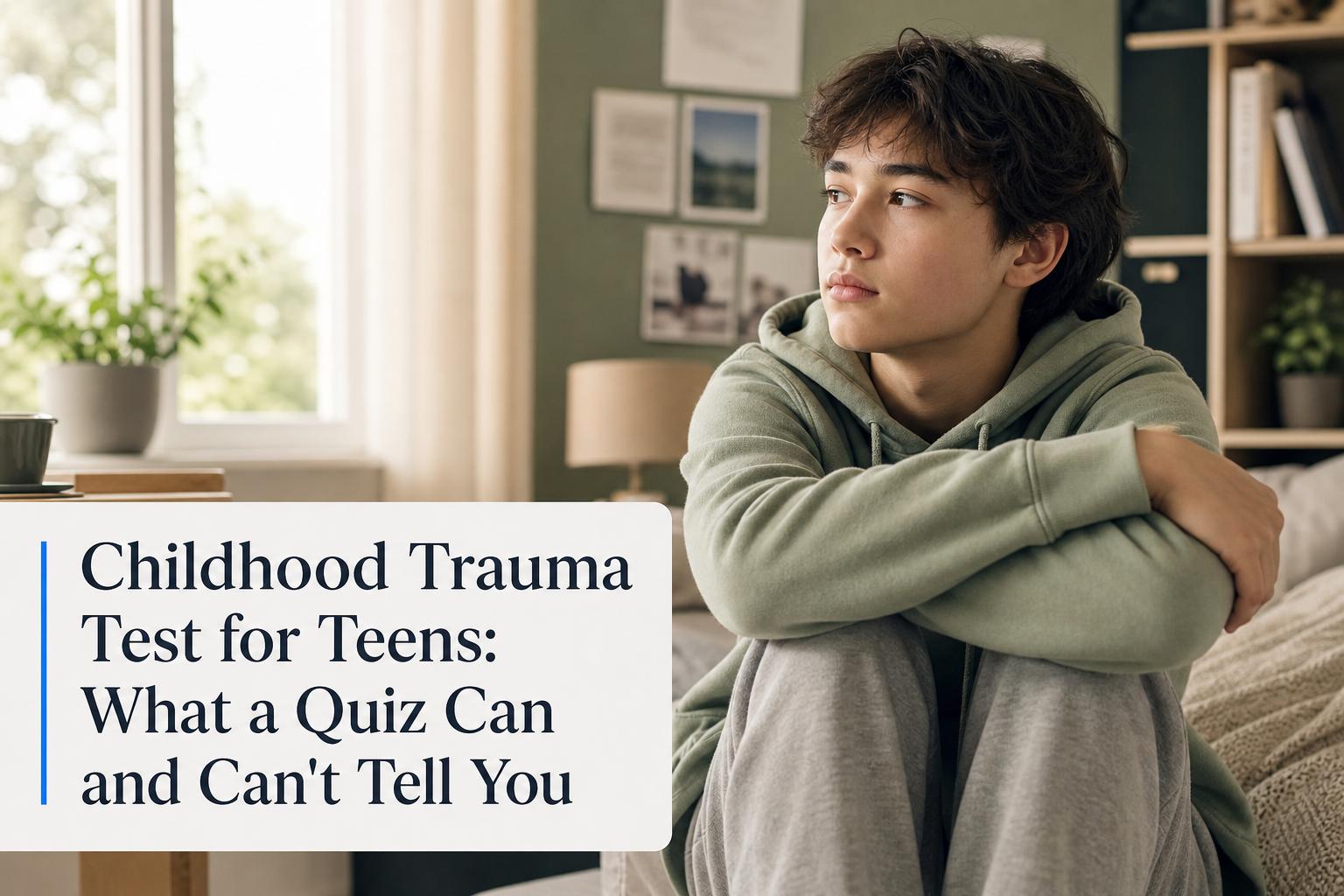
A childhood trauma test you find online usually counts adverse experiences, like the CDC-Kaiser ACE questions, so a score shows how much a teen has been exposed to, not whether they have PTSD or how they'll do going forward. The CDC's ACEs page describes these experiences as risk factors, and only a clinician can diagnose anything. If your teen tells you about abuse, you can contact child protective services.
If your teen is in immediate danger, call 911, or call or text 988 (Suicide & Crisis Lifeline). Mental Health For Teens does not provide emergency or crisis response.
What a Childhood Trauma Test Measures
Most online trauma quizzes ask whether certain things happened before age 18, and they add up the "yes" answers. The best-known version, the ACE questionnaire, was developed from the CDC-Kaiser study and groups experiences into abuse, neglect, and household challenges, such as a parent's incarceration, substance use in the home, or a parent's separation. Each category you check adds a point, so the total tells you how many types of difficulty a young person has been exposed to.
That's all the number holds. A quiz doesn't ask how long something lasted, who the safe adults were, how your teen responded, or whether they're having symptoms today. Two teens can land on the same score and need very different things, and a teen with a score of zero can still be affected by a frightening event the questions never covered, like a car accident, a medical emergency, bullying, or community violence.
Quizzes also depend on who answers them. If a parent fills one out for a teen, it reflects what the parent knows, and teens often hold back details that feel embarrassing or disloyal. If your teen takes it alone, they may read a question differently than it was meant, or feel alarmed by a total they have no one to talk through.
If your teen has seen their result, a calm, low-pressure opening usually works better than a direct interrogation. You might say you saw they were curious about this, that you're glad they looked into it, and that you'd like to hear whatever they want to share. Let them set the pace, and don't ask for details they aren't ready to give.
Treat the result as a reason to start a conversation with a professional, not as an answer. Our anxiety test for teens post takes the same approach to screening tools, and the logic carries over here. A questionnaire can point toward a topic worth exploring, while a clinician sorts out what's actually going on.
What an ACE Score Means and Doesn't Mean
A higher ACE score means a teen has been exposed to more types of childhood adversity, and the CDC links that exposure to a greater chance of health and behavior challenges later in life. The standard questionnaire has 10 questions, so the score runs from 0 to 10. It's a statement about risk across large groups of people, not a forecast for your teen. Many young people with several adverse experiences do well, especially when they have steady adults, supportive friends, and care when they need it. The CDC's ACEs prevention resources describe these protective relationships and environments as part of why outcomes vary so much.
So a score of four doesn't mean your teen has PTSD, and a score of one doesn't mean they're fine. Trauma-related conditions are diagnosed by a clinician who looks at symptoms, how long they've lasted, and how much they interfere with sleep, school, friendships, and home life. The ACE questions don't measure any of that.
Your teen's score also can't tell you what caused a particular worry, mood change, or behavior. Plenty of things can look like trauma stress, including anxiety, depression, and ADHD, and a score alone can't separate them. Some teens with a high score have no current symptoms. Others have a low score and are struggling after one event the questionnaire never asked about.
If you're deciding what to do with a number, these questions are more useful than the total:
- 1Has your teen's mood, sleep, appetite, or school attendance changed in recent weeks?
- 2Are they avoiding certain places, people, or topics more than they used to?
- 3Do they seem on edge, jumpy, or easily overwhelmed?
- 4Have they said anything about hurting themselves?
A yes to any of these is a reason to talk with a clinician, whatever the score says. Our trauma and PTSD treatment page explains how we approach these concerns for teens in California.
If your teen's score is high but they seem to be coping, you don't need to treat it as an emergency. A conversation with a professional can still help you understand what supports to keep in place.
Signs of Trauma Stress in Teens
Trauma stress in teens often shows up as changes in sleep, mood, concentration, and behavior rather than as anything a teen says out loud. The National Child Traumatic Stress Network notes that reactions vary with age and that teens may show them through risk-taking, withdrawal, anger, or physical complaints. You can read more in the NCTSN's guidance on child trauma.
Parents tend to notice these patterns first:
- Trouble falling or staying asleep, nightmares, or new complaints of stomachaches and headaches with no medical cause
- Sudden irritability, outbursts, or a short fuse that seems out of proportion to what set it off
- Pulling away from friends, activities, or family dinners they used to enjoy
- Dropping grades, skipped classes, or difficulty concentrating
- Avoiding reminders of a frightening event, or becoming jumpy around loud noises and unexpected touch
- Increased risk-taking, including substance use
None of these confirms trauma, and most also appear with anxiety, depression, or ordinary adolescent stress. What gives them weight is a change from your teen's usual self that lasts more than a couple of weeks or starts interfering with school, sleep, or relationships. Our guide to signs your teen needs therapy walks through that threshold in more detail.
Some reactions are easy to miss because they look like good behavior. A teen who has gone quiet, keeps to their room, and never causes trouble may be struggling just as much as one who's slamming doors. Watch for emotional numbness too, like a teen who seems flat about things that used to matter to them.
If you're seeing several of these changes, write down what you've noticed, when it started, and what seems to trigger it. A short note with dates helps a clinician far more than a quiz result does, and you can bring it to a free, confidential consultation with us. Our team will then talk with you about which level of care fits, whether that's virtual IOP or outpatient.
What Happens in a Real Trauma Assessment
A real trauma assessment is a conversation with a clinician, usually across more than one sitting, that looks at what your teen has lived through and how they're doing now. No single score decides the outcome. At Mental Health For Teens, families begin with a free, confidential consultation, and a parent or legal guardian completes that step and enrollment.
The clinician will ask about your teen's current symptoms, including sleep, mood, concentration, and avoidance, and how long each has been going on. They'll ask how those symptoms affect school, friendships, and home life, and they'll look at safety, the home environment, and the supports your teen has around them. Those answers shape the level of care, and a diagnosis alone doesn't decide it.
Teens usually get time alone with the clinician, and that matters because many hold back details in front of a parent. Confidential individual time is part of our care, and we explain the safety limits on confidentiality up front, so your teen knows what stays private and what would need to be shared. As a parent, you'll get plain-language updates rather than a transcript of what was said.
Your teen doesn't have to tell the whole story at the first meeting. A good clinician doesn't push for detailed accounts of painful events early on. The aim is to understand enough to choose a safe starting point, and details tend to come out as trust builds.
To prepare, bring the notes we suggested earlier: what you've noticed, when it began, and what seems to set it off. Also bring a list of any current providers or medications, since some teens keep their existing psychiatrist and medication decisions stay with the licensed prescriber. If your teen has already taken an online quiz, you can mention the result, though it will be treated as a starting point for questions.
Because our care is delivered by secure video, your teen needs to be physically in California and have a private space at home for the session. If the assessment shows that home-based care isn't the right fit, for example when a teen is in an active suicidal crisis without a safety plan, we refer you to in-person or higher levels of care.
Why Treatment Focuses on Stabilization First
Teens usually need steady sleep, a working safety plan, and a few reliable coping skills before they can talk through painful memories without feeling worse afterward. That's why trauma-informed care starts by building stability, and why the first weeks of treatment often look more like skills practice than storytelling. The NCTSN describes trauma-informed approaches as ones that prioritize safety and a sense of control for young people before deeper trauma work begins.
In practice, early sessions at Mental Health For Teens focus on how your teen is functioning day to day. The clinical team checks mood, sleep, school, and safety, then teaches skills your teen can use at home, drawing on CBT and DBT. In virtual IOP, that includes DBT skills groups and diary card review. Your teen practices noticing a surge of panic or anger, slowing it down, and getting through the evening without it taking over.
Family sessions and parent coaching are part of this early phase too. Your clinician will likely talk with you about what helps at home, such as predictable routines, calm responses to outbursts, and how to respond if your teen opens up unexpectedly. You don't need to ask for details of what happened. Listening and staying steady matter more than getting the full story.
Processing difficult experiences comes when your teen has enough footing for it, and a clinician decides when that is. Some teens are ready within a few sessions, and others need longer on skills first. Our trauma therapy for teens page describes the methods we use, and the post on stabilization in trauma-informed virtual care goes into the reasoning in more depth.
Progress is tracked with symptom measures, regular check-ins, and goals you can see. If your teen needs less structure, IOP steps down to outpatient, and if they need more, the level can change in the other direction. More hours aren't automatically better, so a clinician recommends IOP only when that intensity fits.
If your teen's quiz result has you wondering where to begin, request a free assessment or call us at 619-354-3569 to set up a free, confidential consultation. If you'd like to check benefits first, we verify insurance before enrollment, and coverage varies by plan.
Written by
Mental Health For Teens
Clinical TeamVirtual IOP and outpatient mental health programs for teens in San Diego and across California.