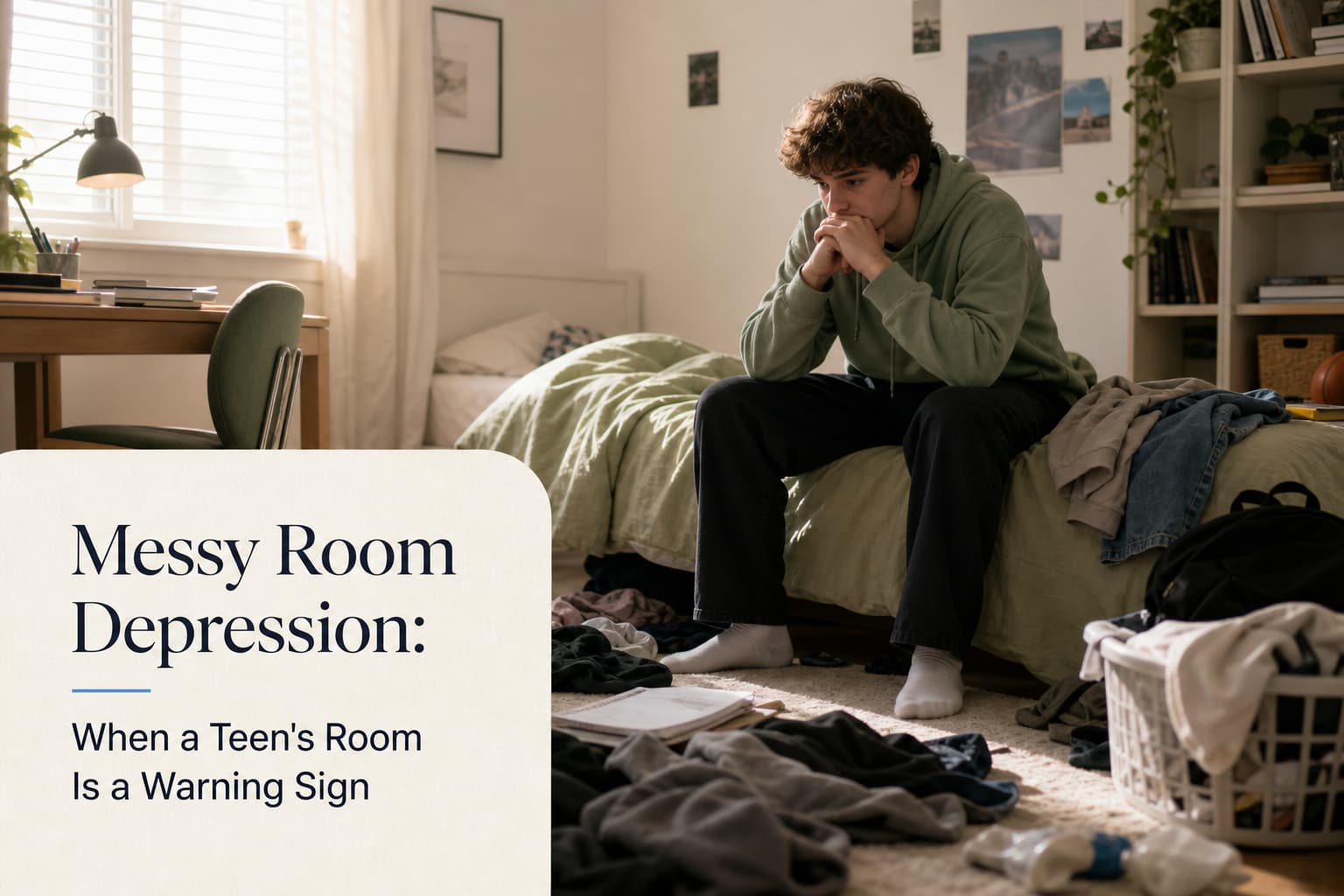


Emotional exhaustion in teens can be burnout from too much stress, depression, or both, and only a clinician can say which. The NIMH describes depression as a persistent low mood or loss of interest lasting at least two weeks (NIMH on depression). Tiredness that tracks a heavy schedule and lifts with real rest points more toward overload.
If your teen is in immediate danger, call 911, or call or text 988 (Suicide & Crisis Lifeline). Mental Health For Teens does not provide emergency or crisis response.
Signs of Emotional Exhaustion in Teens
A drained teen often looks like a student who has run out of fuel. They still show up and still turn in work, but flat and slow. Many parents notice it at home first, when a teen who held it together all day goes quiet after walking in the door.
Common signs include sleeping late on weekends and still waking up tired, going blank or tearful over small tasks like starting a worksheet, and pulling back from friends because texting feels like work. Some teens get irritable at the end of the school day, report headaches or stomachaches, or dread Sunday night. Others say they don't care about things they used to work hard for.
Look at the pattern rather than any single day. Most teens are tired after a test week. What stands out is tiredness that builds over several weeks and gets worse during finals, a sports season, or college applications. Two weeks or more is a reasonable point to start keeping notes.
Your teen may never say the word exhausted. You might hear "I'm fine," "I'm just bored," or "I can't do this anymore." High-achieving teens often keep grades up long after their energy is gone, so good report cards don't rule out a problem.
Our guide to signs your teen needs therapy walks through changes in sleep, energy, mood, and school functioning that are worth bringing to a professional.
Questions That Separate Burnout From Depression
The most useful thing to check is what happens to your teen's mood when the pressure actually stops. After a long weekend or a canceled practice, a teen with overload often perks up a little, while the flatness of depression tends to follow them into free time.
A second marker is whether the problem has a source. Burnout usually points at a class, a sport, or a job, while depression tends to spread into things your teen used to love. Listen to how your teen talks about themselves too. "I'm so behind" sounds like overload, and "I'm worthless" or "nothing will ever get better" sounds like something deeper.
Think back to what changed first. In burnout, energy and motivation often drop before mood. In depression, mood, sleep, appetite, and self-worth often shift together, sometimes with no obvious trigger. Hopelessness about the future deserves a prompt conversation with a professional, even if the schedule is also packed.
Your answers won't produce a diagnosis, and the two can overlap. A teen who's overloaded for months can slide into depression, and a depressed teen can look simply overscheduled. A clinician sorts that out by looking at symptoms, daily functioning, and safety.
Raise it in a low-pressure moment, like a car ride. Saying "You seem wiped out lately, and I'm wondering what a good day would look like for you" gives your teen room to answer honestly. If what you're seeing matches our overview of teen depression treatment, a free consultation can help you decide what level of support fits.
**Selected references**
National Institute of Mental Health, Depression: https://www.nimh.nih.gov/health/topics/depression
Common Causes: School Load, Activities, Family Stress, and Caregiving
Emotional exhaustion in teens usually builds when several demands stack up and no day is truly off. To find the source, map your teen's typical week across all seven days, including homework, practice, commuting, work shifts, and late-night screen time, then mark the days with no real downtime.
School load is often the biggest piece. Honors or AP classes, a heavy homework night after a full practice, and a run of tests leave little room to recover. Competitive activities add to it, especially when a teen feels they can't quit because of a team, a scholarship hope, or a college résumé.
Family stress counts even when it isn't aimed at your teen. Ongoing conflict, a move, a divorce, money worries, or a parent's illness all use up energy a teen then doesn't have for school. Some teens also take on caregiving, like watching younger siblings, translating for relatives, or helping a sick family member. A teen who's on duty every evening has no time to rest, even if everyone calls it helping out.
The CDC describes stress and family circumstances as factors that affect children's mental health, which is why we ask about home life as well as school.
While you map the week, ask your teen which part they dread most, what they'd drop first, and when they get time that belongs only to them. If the answers point to one clear source, lightening that piece is a reasonable first step. If your teen can't name anything, or the exhaustion seems bigger than the schedule explains, a clinician can look at mood, sleep, and safety together. Our post on after-school restraint collapse explains why many teens fall apart at home after holding it together all day.
**Selected references**
Centers for Disease Control and Prevention, About Children's Mental Health: https://www.cdc.gov/mental-health/about/about-children-s-mental-health.html
Changes at Home and at School That Lower the Load
Start by protecting one block of unscheduled time each day, even 30 to 45 minutes, where your teen owes nobody anything. That means no homework, chores, practice, or check-in about grades. Teens running on empty usually can't create that gap themselves, because every open hour looks like time to catch up, so you may need to say it out loud. Something like "That time is yours, and I won't ask what you did with it" works.
Look at what you can take off the schedule before adding anything new. Move one evening commitment, pass a caregiving duty like sibling pickup to another adult for a few weeks, or let one late assignment slide while you sort out the week. Protect sleep most of all by keeping phones out of the bedroom and holding a steady weekend wake time.
At school, the counselor is the best first call. Ask about moving a deadline, spacing out tests, dropping one advanced class, or a lighter load next semester. We can write a school coordination letter on request, though enrollment with us doesn't create a 504 plan or IEP, so formal accommodations go through the school's own process.
Give a change two to three weeks before you judge it. Small early signs of overload easing include a bit more energy after school, a laugh at dinner, or less dread on Sunday night. If the flatness, hopelessness, or loss of interest stays the same after the schedule gets lighter, the load wasn't the whole story, and that's the time to talk with a clinician rather than cut back further.
Let your teen help choose what goes. A teen who picks which activity to drop feels heard, while one who's told to quit a team may hear that you think they're failing. If you're unsure how much therapy support would fit, our post on how often a teen should go to therapy explains how frequency is matched to what a teen needs.
When to Get Professional Help for a Drained Teen
Reach out when the exhaustion has lasted more than a few weeks, when it hasn't eased after you've lightened the schedule, or when you notice hopelessness, talk of being a burden, or a drop in sleep, eating, or school attendance. Any mention of self-harm or suicide calls for a same-day conversation with a professional. The AAP and AACAP both encourage parents to bring persistent changes in mood, sleep, and functioning to a pediatrician or mental health clinician.
If you're not sure it's serious enough, a free, confidential consultation with us is a low-stakes way to find out. A parent or legal guardian completes it, and there's no obligation to enroll. Have a few notes ready on when the tiredness started, what changed after any breaks, how your teen is sleeping and eating, and how school is going.
The right level of care depends on safety, daily functioning, and how much support your teen has at home, not on a label. Many teens do well with outpatient therapy, which is one to three evening sessions with a consistent individual therapist. Virtual intensive outpatient adds group, individual, and family therapy for about 9 to 12 hours a week, and we recommend it only when that intensity fits. If your teen starts in one and needs more or less, the level can change.
All care is by secure video, so your teen stays home and in school. Your teen needs to be physically in California during sessions and have a private space at home. We don't provide emergency care, inpatient care, or in-person treatment, and if home-based care isn't the right fit, we'll point you toward a higher level of care.
If you'd like to talk it through, request a free assessment or call us at 619-354-3569.
**Selected references**
American Academy of Pediatrics: https://www.aap.org
American Academy of Child and Adolescent Psychiatry: https://www.aacap.org
Written by
Mental Health For Teens
Clinical TeamVirtual IOP and outpatient mental health programs for teens in San Diego and across California.