

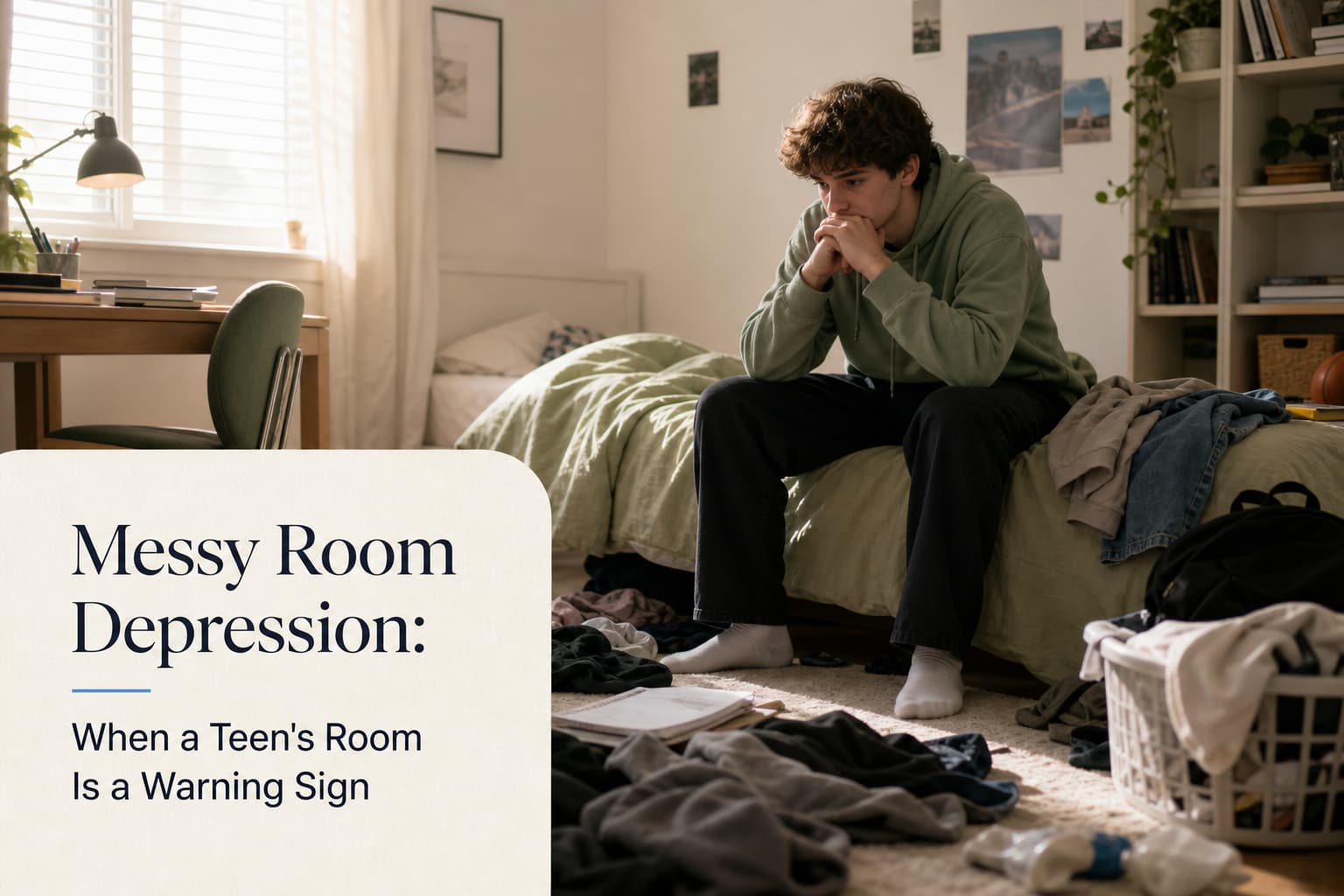
A messy room on its own isn't a sign of depression, but messy room depression is worth considering when a room suddenly becomes unlivable alongside low mood, poor sleep, or pulling away from people. The National Institute of Mental Health lists changes like these among the signs of depression in teens. A clinician can sort out what's behind them, and you don't have to figure it out alone.
If your teen is in immediate danger, call 911. You can also call or text 988 (Suicide & Crisis Lifeline) any time. Mental Health For Teens doesn't provide emergency or crisis response.
Messy Room Depression Versus Normal Teen Mess
Normal teen mess has a pattern you can usually see. Clothes cover the floor, the desk is buried in papers, and the bed is unmade, but your teen can still find a charger, sleep in the bed, and have a friend over without embarrassment. It's annoying and it's steady, looking about the same in March as it did in October.
Parents who describe messy room depression tend to say the room changed fast and the teen changed with it. Plates and cups stay for days. Laundry never gets washed, so there's nothing clean to wear. The bed becomes unusable, or the teen stops sleeping in it, and trash sits where it fell. Your teen may also stop caring about things they used to protect, like a favorite shelf or a hobby corner.
Three questions help you sort the two. Check whether the room changed over a few weeks rather than years. Notice whether your teen seems unable to start rather than unwilling. Watch whether they look worn out, flat, or irritable when you mention it, instead of annoyed in the usual way. A teen who says "I can't deal with it" and means it is telling you something different from a teen who shrugs and says "later."
None of this diagnoses anything, since a room can fall apart for reasons unrelated to depression. A clinician weighs mood, sleep, school, and safety together. Your observations still matter because you know your teen's baseline. Write down roughly when the room shifted and what else was happening then, because that timeline helps anyone you talk to later. Even a two-line note with a rough month and one or two events is enough.
Other Reasons a Room Falls Apart: ADHD, Overwhelm, and Anxiety
Executive function problems are a common reason a capable teen can't keep a room livable, and they often get mistaken for laziness. Executive function covers planning, starting tasks, and keeping track of objects. A teen with ADHD may know exactly what "clean your room" means and still be unable to break it into steps, so the pile grows while they feel worse about it. The CDC describes difficulty with organization and follow-through as part of how ADHD can show up in daily life. If your teen has always struggled with homework deadlines, lost belongings, or unfinished chores, the room may be one more place that pattern shows. Our ADHD treatment for teens page explains how we support focus and organization skills, though we don't provide ADHD diagnostic evaluations.
Overwhelm looks similar from the doorway. A teen carrying heavy schoolwork, friend conflict, or a packed activity schedule may have no energy left once evening comes, so the room goes first. The giveaway is timing, because the mess tracks with a stressful stretch, such as finals week, and eases when the pressure does.
Anxiety can push in two directions. Some anxious teens freeze at a big, unclear task and avoid the room entirely, while others avoid it because it holds reminders of unfinished work or things they dread. A teen who hoards clutter for comfort, or can't decide what's safe to throw away, is showing something a clinician would want to hear about.
Look at what the mess comes with. Mess plus lifelong disorganization points toward ADHD, mess plus a rough month points toward stress, and mess plus flat mood and withdrawal points back toward depression. A free, confidential consultation with our team is a reasonable place to describe what you're seeing.
Signs to Look For Besides the Room
Sleep, appetite, and how your teen spends the hours after school will tell you more than the floor does. The National Institute of Mental Health lists persistent sadness or irritability, loss of interest in activities, changes in sleep or appetite, low energy, trouble concentrating, and feeling worthless or hopeless among the signs of depression in teens. Look for several of these lasting most days for two weeks or longer, not a single bad afternoon.
These are the changes parents most often notice alongside a room that's fallen apart:
- Sleeping far more or far less than usual, or being awake all night and impossible to wake in the morning
- Dropping a sport, band, game, or friend group they used to love
- Eating much less, or skipping meals without comment
- Slipping grades, missed assignments, or skipped classes
- Snapping at small things, or going quiet and flat when you ask a simple question
- Neglecting showers, clean clothes, or hair, which often shows up around the same time the room does
- Comments like "what's the point" or "nobody would notice"
Our posts on why teenagers sleep so much and a teen who is failing school and doesn't seem to care can help you separate ordinary teen patterns from changes worth raising with a professional.
Pay the closest attention to talk of hopelessness, being a burden, or not wanting to be here. Treat those words seriously even if they're said casually, and ask your teen about them directly. Asking doesn't plant the idea. If you hear them, use the crisis options above right away rather than waiting for a scheduled appointment.
This list can't diagnose your teen, but it gives you specific observations to share with a clinician. Our teen depression treatment page describes what that kind of care looks like.
Talking About the Room Without a Fight
Start the conversation somewhere other than the room, ideally side by side in the car or on a walk, and open with your teen instead of the mess. Something like "You've seemed worn out lately, and I've noticed the room is harder to keep up. What's getting in the way?" gives them a way to answer without defending themselves. A talk across a doorway full of laundry tends to feel like an inspection.
Pick a calm moment, not right after a missed assignment, not when you're already frustrated, and not when friends are within earshot. Ten minutes is plenty for a first try.
Ask one question, then listen longer than feels natural. If your teen says "I don't know" or "I just can't, " take it at face value and ask what the hardest part is: starting, deciding what to keep, or feeling too tired. Their answer will tell you if you're looking at overwhelm, trouble with planning, or low energy, and it gives you something concrete to bring to a clinician.
Leave out words like "lazy, " "disgusting, " and "why can't you just." Taking away a phone or a door as a consequence for a room your teen may be physically unable to tackle usually adds shame without adding skill. If your teen has told you they're exhausted or hopeless, the room can wait.
If they shut down, let it go and say you'll check in again in a day or two. Many teens need a second conversation before they say anything real.
When these talks keep ending in the same argument, parent coaching can give you language and a plan for hard conversations, and it's built into our care rather than billed as an add-on.
A Simple Low-Conflict Reset Plan
Start with one surface, not the whole room, and do it with your teen for about 15 minutes. The bed is usually the best choice, since a made bed with clean sheets gives a teen who's barely sleeping somewhere to rest. Sit nearby, hand them things, and let them decide what stays.
Here's a sequence that keeps the task small enough to finish:
- 1Trash and dishes first. Bring a bag and a tray. Removing the cups and wrappers changes how the room smells and looks, and it takes no decisions.
- 2Laundry into one basket. Don't sort it yet. Run one load together so there's something clean to wear.
- 3One clear surface. Pick the bed or the desk, and stop when it's done.
- 4A short repeat. Agree on five minutes a day or one longer session a week, at a time your teen picks.
Keep the goal at "livable, " not "tidy." A floor you can walk across and a bed you can sleep in are a win, and you can praise the effort without commenting on what's left.
Offer specific help in place of a deadline. Labeled bins, a laundry basket by the door, and a phone reminder your teen sets themselves all lower the number of steps. If your teen has trouble starting, sitting in the room with them often does more than any checklist.
Give the reset about two weeks. If the room improves but your teen still seems flat, exhausted, or withdrawn, the room wasn't the main problem. If your teen can't manage even the smallest step, or the mess keeps returning alongside the signs listed earlier, bring that pattern to a clinician along with your notes on when it began.
When an Evaluation Makes Sense
Book an evaluation when the room, the mood changes, or the sleep and appetite shifts have lasted two weeks or more, or when they're getting in the way of school, friendships, or basic self-care. You don't need to wait for a crisis, and your teen doesn't have to agree that something is wrong before you ask a professional for guidance. Your teen's pediatrician is a reasonable first stop, since a medical visit can rule out physical causes such as thyroid problems or anemia that sap energy.
Come with specifics. Bring your notes on when the room changed, what else shifted around then, and what your teen said when you asked what makes it hard. A clinician will usually ask about mood, sleep, school, safety, and how things are going at home, and they'll want to talk with your teen alone for part of the visit.
If you'd like to talk with us, we start with a free, confidential consultation, and there's no obligation to enroll. A parent or legal guardian completes the consultation and enrollment steps. Our care is delivered by secure video, and your teen needs to be physically in California with a private space at home for sessions. A clinician weighs safety, daily functioning, and available support to recommend a level of care, either weekly outpatient therapy or our virtual IOP. More hours aren't automatically better, so the recommendation is matched to what your teen needs. If home-based care isn't appropriate, we'll tell you up front and refer you to in-person or higher levels of care.
Insurance benefits vary by plan, and we verify them before enrollment so you know your estimated out-of-pocket costs.
To talk through what you're seeing, book a free consultation at mentalhealthforteens.com or call 619-354-3569.
Written by
Mental Health For Teens
Clinical TeamVirtual IOP and outpatient mental health programs for teens in San Diego and across California.