
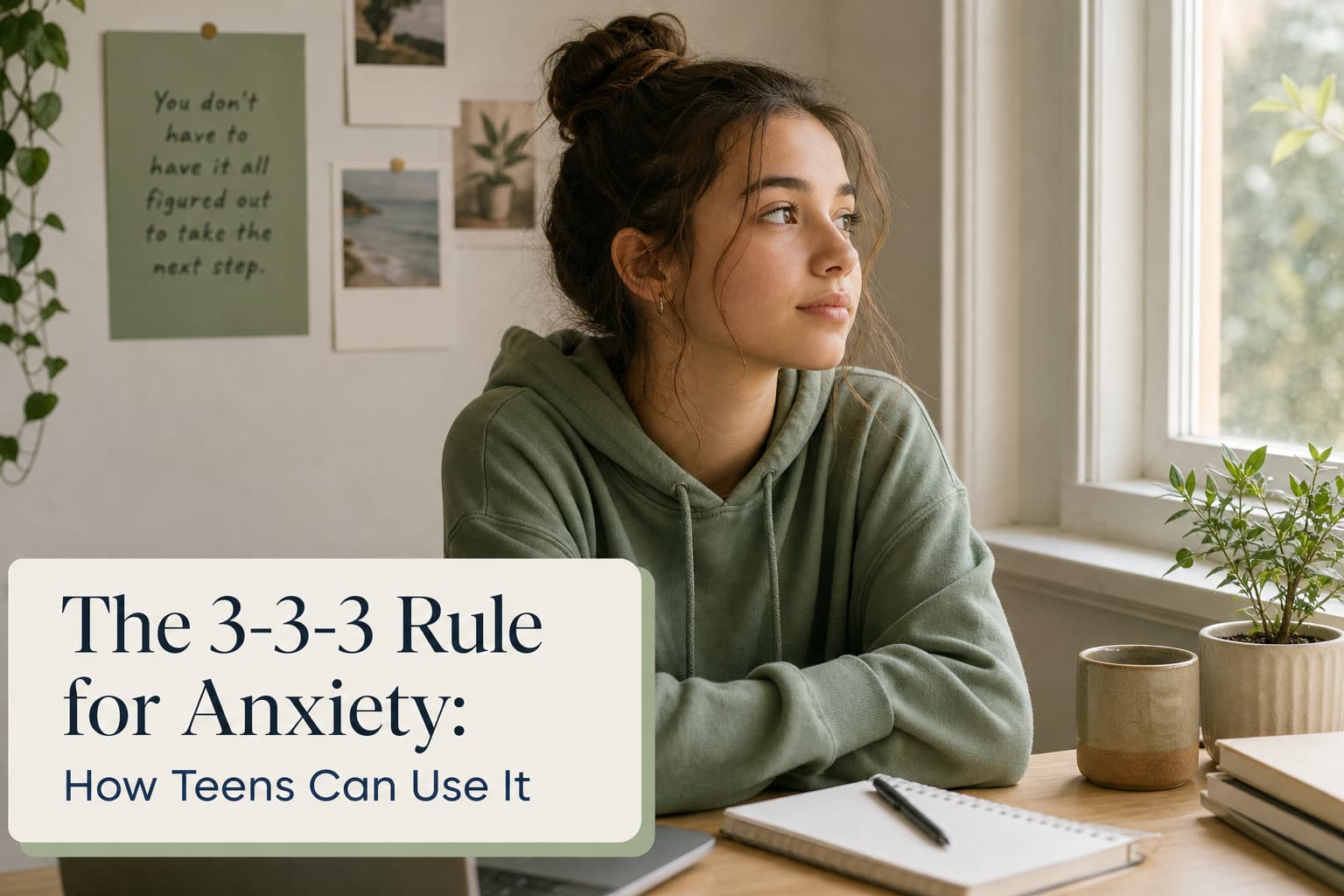
The 3-3-3 rule for anxiety is a quick grounding exercise: your teen names three things they see, three sounds they hear, and moves three parts of their body. It's a coping skill to practice when worry spikes, and it doesn't replace treatment.
What the 3-3-3 Rule for Anxiety Asks a Teen to Do in Three Parts
The first part is looking. Your teen picks three things in the room and names them, in their head or out loud, such as the clock, a backpack zipper, or a poster on the wall.
The second part is listening. They name three sounds, which might be a hallway door, a fan, or a car outside.
The third part is moving. They shift three parts of the body, for example wiggling their toes, rolling their shoulders, or opening and closing their hands.
Try it yourself once before you teach it, so you can show your teen what it looks like and answer questions about how it feels. Let them adjust it too. Some teens like a slow breath between each part, and others prefer to name whatever stands out instead of counting to three.
Practice on an ordinary afternoon rather than for the first time in the middle of a panicky moment. Clinicians ask teens to practice skills between sessions for the same reason, so the skill is familiar before it's needed.
How to Do the 3-3-3 Rule Step by Step in Five Moves
Run through the rule together once in this order before your teen tries it alone.
- 1Pause and plant your feet. Your teen sits or stands where they are and rests their feet flat on the floor.
- 2Name three things you see. Eyes move slowly from one object to the next, and a quiet inner voice is enough.
- 3Name three sounds you hear. Start with the faintest one, like a vent or a pencil scratching.
- 4Move three body parts. Ankles, fingers, and shoulders are easy choices in a classroom because the movement is small.
- 5Check in. Your teen asks themselves whether the worry feels a little lower, the same, or higher, and any answer is useful information.
If the first round doesn't settle things, your teen can repeat it once with new objects and sounds. If the second round doesn't help, that's a reason to try another skill or ask for support, not to push harder.
At school, agree on a plan ahead of time. Some teens quietly ask a teacher for a few minutes in the hallway, while others do the steps at their desk. At night the same steps can be done lying down.
Afterward, ask what felt easy and what felt awkward, then adjust. A teen who dislikes naming things aloud might write three words on a sticky note instead.
Why Grounding Can Help in an Anxious Moment, Round by Round
Anxiety pulls attention toward things that haven't happened yet, and naming what's in the room right now gives the mind a concrete task in the present. For some teens that loosens the worried thought for a few minutes.
The body is part of it too. Muscles tighten and breathing gets shallow during a spike of worry, so a small, deliberate movement like the third step gives that tension something else to do. Grounding comes out of mindfulness, which is the practice of noticing the present moment without judging it, and mindfulness therapy is one of the methods our clinicians use.
Your teen probably won't feel calm afterward. A realistic result is that the worry drops a notch or becomes easier to sit beside. The check-in in step five shows your teen what helps them, since some find sounds steadier than sights and others lean on the movement.
Early rounds can seem silly or too simple, but repetition makes the exercise easier to reach for. Our clinical team works with teens on mindfulness in mindfulness therapy for teens, where a clinician can adjust skills to fit the teen.
When the 3-3-3 Rule Doesn't Help Enough After Two Rounds
If your teen runs the rule twice and the worry hasn't dropped at all, or it keeps coming back several times a day, the skill is telling you something useful. A grounding exercise can take the edge off a spike, but it can't change the thinking patterns or the avoidance that keep anxiety going.
Watch for a few patterns over several weeks. Your teen may need the rule just to get through the school morning, or they may be using it to put off the thing they're afraid of instead of facing it. Panic that arrives with a racing heart, trouble breathing, or a sense of losing control can also be too strong for a quick exercise. Our post on teen panic attacks and when outpatient care becomes IOP walks through what changes as symptoms get more frequent.
If your teen skips classes, drops activities, or stays home to dodge the feeling, grounding can quietly become one more way to escape discomfort. We explain how that cycle works in the worst habit for teen anxiety.
Try not to read a failed round as a sign your teen did it wrong or that you taught it badly. Tell them the rule is one tool, and that needing more than one is common. Ask what they noticed during the exercise, and whether sleep, school, or friendships have changed lately. A clinician can say what's behind those changes, so you and your teen don't have to work out a diagnosis alone.
If the rule keeps falling short, a free, confidential consultation with Mental Health For Teens is a reasonable next step. We'll ask about symptoms, safety, and daily functioning, then talk through whether outpatient or virtual IOP fits.
Mindfulness and DBT Distress Tolerance Skills Teens Learn in Treatment
Teens in our programs learn mindfulness and DBT distress tolerance as skills for getting through a hard moment, and they go further than a single exercise like the 3-3-3 rule. These skills are taught for moments when the feeling is too strong to think through, so the goal is to get through the next few minutes without making things worse. Our page on DBT therapy for teens explains how these skills are taught.
In our virtual IOP, clinician-led skills groups meet on Tuesday, Wednesday, and Thursday evenings after school, and teens review a DBT diary card with the clinical team. A diary card is a simple daily record of feelings, urges, and which skills the teen tried. For you, that means a teen who can say "I used a skill, and here's what happened" instead of only "I felt awful." Outpatient care covers similar skills in one to three sessions with the same individual therapist.
Mindfulness is taught as its own practice, and teens use it for more than emergencies. Clinicians also help teens sort out which skill fits which moment, since what helps with a racing heart before a quiz may not help with a low mood that lingers all weekend.
Parents learn the same vocabulary through family sessions and parent coaching, both built into care. You'll hear which skills your teen is practicing, so you can offer a calm prompt at home, such as "Do you want to try one of your skills?" instead of "Just relax."
When Anxiety Is More Than a Coping-Skill Problem for Your Teen
Anxiety has moved past what a coping skill can handle when it keeps interfering with sleep, school, or friendships for several weeks, even though your teen is practicing. A clinician makes any diagnosis, so your job is to describe what you see, not to label it. Notes on how often the worry shows up, what sets it off, and what your teen does to get away from it will make the first conversation go faster.
Frequent absences, trouble getting out the door in the morning, panic several times a week, or a teen who can't settle at night without a parent nearby are all worth raising. Our page on teen anxiety treatment describes how we approach these concerns.
When you reach out, you'll start with a free, confidential consultation that a parent or legal guardian completes. We'll ask about symptoms, safety, home environment, and how school is going, then match your teen to outpatient or virtual IOP. A diagnosis doesn't decide the level of care, and the level can change later if your teen needs more or less support. More hours aren't automatically better.
Care is by secure video, so your teen needs to be physically in California and have a private space at home. Start dates are set around the school schedule at intake.
Call us at 619-354-3569, or request a free consultation, and we'll talk through what you've noticed and what the next step could look like for your family.
Written by
Mental Health For Teens
Clinical TeamVirtual IOP and outpatient mental health programs for teens in San Diego and across California.