
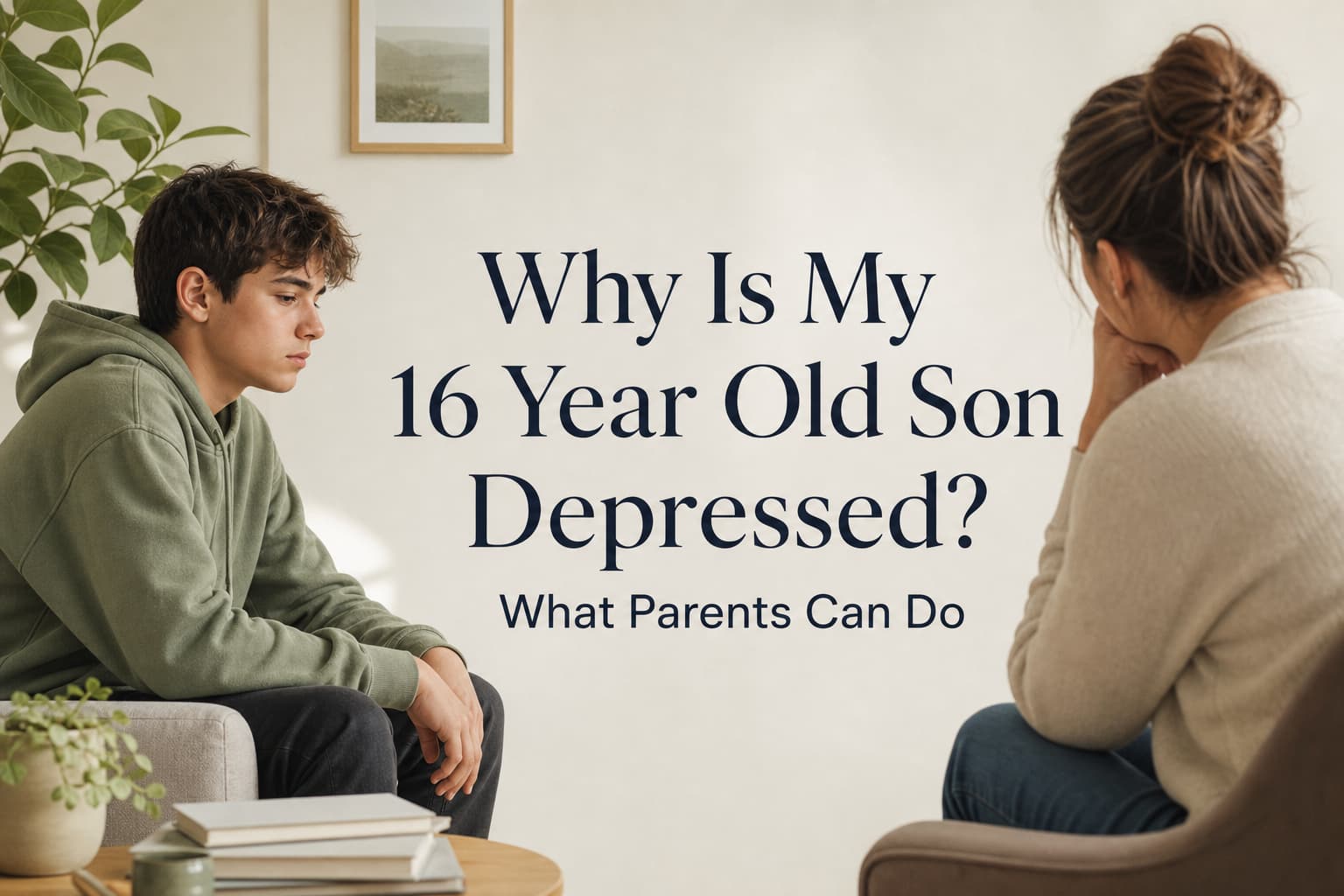
When you ask why your 16-year-old son seems depressed, the honest answer is that there's rarely one cause. Stress, poor sleep, a loss or conflict, bullying, substance use, and family history can all contribute, and in boys depression often shows up as irritability rather than sadness (NIMH). A clinician is the one who can tell you what's actually going on.
If your son is in immediate danger, call 911, or call or text 988 (Suicide & Crisis Lifeline). Mental Health For Teens doesn't provide emergency or crisis response.
Why a 16-Year-Old Son With Depression Often Looks Angry Instead of Sad
Many boys at 16 don't have the words for low mood, or they've learned that sadness isn't something to show, so it comes out as snapping at you, shutting the bedroom door, or picking fights over small things. A parent watching this sees a bad attitude. A clinician may see a teen whose mood has been low for weeks and who has no other way to say so.
The changes parents notice first are usually about behavior, not tears. He may stay up until 3 a.m. and sleep through the morning, or sleep far more than he used to. He may spend hours gaming, not because he's enjoying it, but because it's the one place he doesn't have to feel much. Grades may slip because he can't concentrate or doesn't see the point, and he may drop sports or stop answering friends' texts. Some boys complain of headaches or stomachaches, or say they're just tired all the time. The American Academy of Child and Adolescent Psychiatry also describes irritability, withdrawal, and changes in sleep and school performance as common ways depression appears in teens.
None of these signs diagnoses anything on its own. What a clinician looks at is the pattern: how long it's lasted, whether it's a change from how he used to be, and how much it's interfering with school, friendships, and home life.
If you've already been wondering why he's so angry, our post on why a teenager is so angry covers that side of it. And if his grades are the loudest signal at your house, a teen who's failing school and doesn't care is worth reading alongside this one.
Telling Depression Apart From Normal Teenage Moodiness
Ordinary teenage moodiness comes and goes with events, while depression tends to hang on for weeks and spread into most parts of his life. The National Institute of Mental Health describes teen depression as a persistent low or irritable mood, or a loss of interest, that lasts and interferes with daily life. A bad week after a breakup or a failed test usually lifts once the sting fades. A mood that doesn't lift is a different thing.
Three questions can help you sort out what you're seeing:
- 1**Duration:** Has this gone on for two weeks or more, without many good days in between?
- 2**Change:** Is he different from the boy he was a year ago, not just different from what you'd like?
- 3**Reach:** Is it affecting school, friends, sleep, and home all at once, or just one area?
A boy who's sulky about a curfew but still laughs with friends, eats normally, and shows up for things he likes is probably dealing with ordinary adolescence. A boy who has stopped caring about things he used to love, even when nothing bad is happening, deserves a closer look.
Pay attention to whether he still has moments of enjoyment. Many teens with depression can brighten briefly around friends or a favorite game, so a good hour doesn't rule anything out. What matters is how the weeks add up.
These questions are a way to organize what you've noticed, not a test he can pass or fail. Only a clinician can diagnose depression, and bringing your notes to that conversation, such as dates, sleep patterns, and grade changes, makes the evaluation more useful. If you'd like a sense of what an evaluation looks like, our free assessment is a place to begin.
What Might Be Behind Depression at 16
Sixteen is a year when several pressures stack up at once, and any of them can be part of why a boy's mood drops. Looking at the possibilities can help you decide what to mention to a clinician, but it doesn't tell you which one is driving things in your son.
School and future pressure is common at this age. Junior year brings harder classes, college questions, and often a job or driving schedule on top of sports. Sleep loss makes everything worse, and a teen who's up until 3 a.m. is running on a brain that never fully rests. The CDC lists changes in sleep among the signs worth watching in children and teens.
Loss and conflict matter too. A breakup, a friendship that ended, a move, a parents' separation, or a death in the family can set off low mood that doesn't lift. Bullying, including the kind that happens in group chats and gaming lobbies, is another possibility you may not hear about unless you ask gently.
Substance use can be a cause, a result, or both. Some teens use vaping, alcohol, or cannabis to take the edge off a mood they can't explain, and those substances can deepen it.
Family history raises the likelihood of depression, according to NIMH. If a parent, aunt, or grandparent has had depression or anxiety, tell the clinician, even if it was never treated.
Some boys also have another condition running alongside, such as anxiety or ADHD, that wears them down over time. A clinician looks at all of this together, and a diagnosis alone doesn't decide what level of care fits. Safety, daily functioning, and the support around him matter just as much. If you want to see how we think about low mood in teens, our page on teen depression treatment explains the approach.
How to Bring It Up With Your Son Without a Lecture
Pick a moment when you're side by side doing something else, like driving, walking the dog, or sitting through a game, because most 16-year-old boys talk more easily when nobody is staring at them. Avoid starting right after a fight, a bad grade, or a missed curfew, since he'll hear anything you say as part of the argument.
Start with what you've seen, not what you think it means. Something like "I've noticed you're up late a lot and you seem worn out, and I'm worried about you" gives him nothing to push back on. Skip "why" questions and labels such as "you're depressed" or "you've got an attitude." Boys tend to hear those as accusations. Then ask one open question and stop talking. Silence is uncomfortable, but he may need ten seconds to answer.
Expect a shrug, an eye roll, or "I'm fine." That's a common first response and doesn't mean the conversation failed. You can say, "Okay, I'm not going anywhere, and I'll ask again later." Short, repeated check-ins usually work better than one long talk.
If he does open up, listen first. Try "That sounds really hard" before you offer any fixes, and resist the urge to talk him out of how he feels. Let him know that seeing a therapist isn't a punishment, and that he'll have confidential time of his own. With us, safety limits on confidentiality are explained up front, and parents get plain-language progress updates, so he knows how it works before he starts.
If he won't talk to you at all, that's useful information too. A coach, relative, or school counselor he trusts may reach him, and you can still request a free, confidential consultation yourself. A parent or legal guardian completes that step, and you can bring your notes on sleep, mood, and school even if he isn't ready to join. Our parent coaching can also help you plan what to say before the next attempt.
When to Seek a Professional Evaluation
Book an evaluation if the low or irritable mood has lasted two weeks or more, or sooner if it's keeping him from school, friends, or sleep. You don't need to wait for him to say he's sad, and you don't need certainty that it's depression. The American Academy of Pediatrics encourages families to raise mood concerns with a pediatrician, and that visit is a reasonable first stop if you'd like a medical check on sleep, energy, and physical complaints.
Some signs mean you shouldn't wait for the next appointment. Talk of death or of being a burden, giving away belongings, self-harm, or a sudden drop in functioning calls for same-day action through the crisis numbers at the top of this post, not a consultation. Our suicidal ideation resource explains what to watch for.
If the situation is worrying but not an emergency, the next step with us is a free, confidential consultation. A parent or legal guardian completes it. Have a few things ready:
- 1Rough dates for when the changes began.
- 2His sleep pattern and any shifts in eating, gaming, or school performance.
- 3Any known family history of depression, anxiety, or substance use.
- 4Current medications and the name of his pediatrician or psychiatrist, if he has one.
During the consultation, we ask about safety, how he's functioning day to day, and what support he has at home. From that, the clinical team recommends virtual IOP or outpatient care. A diagnosis alone doesn't decide that. More hours aren't automatically better, and IOP is recommended only when that intensity fits him.
Your son doesn't have to agree before you make the call. Many teens soften once they learn the sessions are online, after school, and that he'll have time that's his own.
What Treatment Usually Involves
Treatment for a teen with depression usually starts with talk therapy that teaches him to notice how thoughts, mood, and behavior feed each other, and the National Institute of Mental Health names psychotherapy as a standard first approach for teen depression. Medication is sometimes part of the plan, but that decision belongs to a licensed prescriber, and some teens keep the psychiatrist they already see.
At Mental Health For Teens, care happens over secure video from your home, so he doesn't miss school or travel to a clinic. In virtual IOP, he'll typically spend about 9 to 12 hours a week in group, individual, and family therapy on Tuesday, Wednesday, and Thursday evenings, with CBT and DBT skills built in. Outpatient is lighter, with one to three sessions a week and the same individual therapist each time. Our virtual IOP for teens page walks through a typical week.
You'll be involved too. Family therapy and parent coaching are part of both levels, and you'll get plain-language progress updates while he keeps confidential time with his therapist. The team tracks progress through symptom measures and check-ins on mood, sleep, school, and safety, so you can see whether the changes you noticed are easing.
Treatment isn't fixed. When his symptoms, daily functioning, and safety support it, IOP steps down to outpatient, often with the same clinician.
Insurance benefits vary by plan, and we verify them before enrollment and explain estimated costs in plain language. To take the next step, request a free consultation or call 619-354-3569. It's confidential, you're under no obligation to enroll, and a parent or legal guardian completes it.
Selected references
National Institute of Mental Health, Teen Depression
Written by
Mental Health For Teens
Clinical TeamVirtual IOP and outpatient mental health programs for teens in San Diego and across California.