
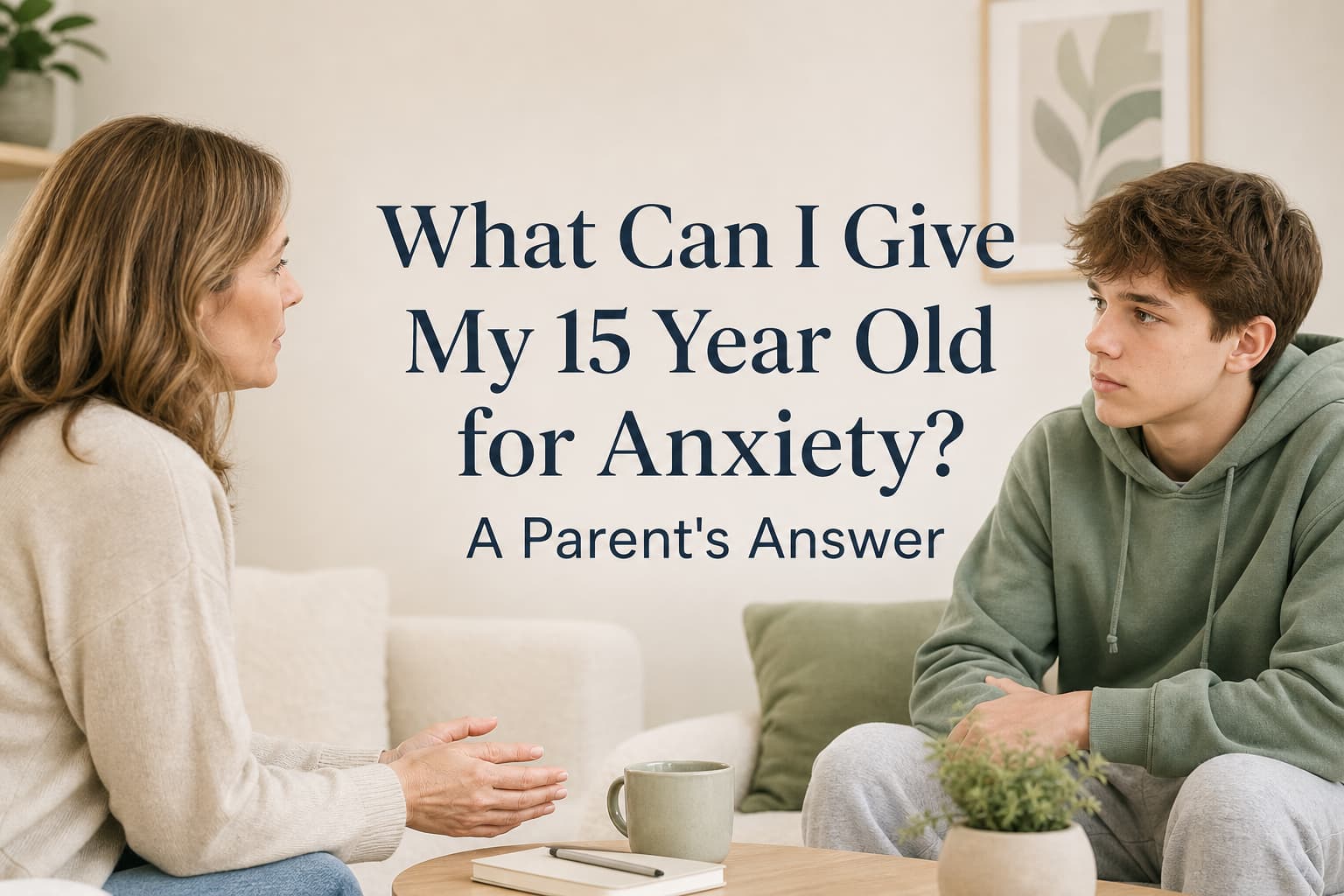
Nothing you can buy at a pharmacy or health food store is a treatment for a 15-year-old's anxiety, so please don't give your teen a supplement, a sleep aid, or anyone else's medication. Start with a call to the pediatrician, because therapy such as CBT is the first-line treatment and any medication decision belongs to a prescriber. There are also things you can do at home this week that genuinely help.
What You Can Give Your 15 Year Old for Anxiety: Supplements and Over-the-Counter Products
The FDA doesn't approve dietary supplements to treat, cure, or prevent any condition, which means a bottle labeled "calming" or "stress support" hasn't been shown to treat a teen's anxiety. The FDA's guidance on dietary supplements explains that these products aren't reviewed for safety and effectiveness before they're sold the way prescription medicines are.
That matters for a 15-year-old for a few practical reasons. Labels don't always match what's in the bottle, and ingredients can interact with prescriptions a teen already takes, including ones for ADHD, asthma, or allergies. Over-the-counter sleep aids and cold medicines can also cause drowsiness, agitation, or a racing heart, and those effects can feel a lot like anxiety, so a teen may seem worse rather than better.
Before you buy anything, it helps to check what's already in your house. If your teen has been taking something on their own, such as a supplement a friend recommended, an energy product, or a family member's pills, tell the pediatrician at the first visit. That isn't about getting your teen in trouble. It gives the doctor an accurate picture, and it's one of the most useful things you can bring to the appointment.
If you're not sure whether something your teen took is safe, call the pediatrician's office or Poison Control at 1-800-222-1222 and ask before the next dose.
You can also ask your teen, calmly and without an interrogation, what they've tried to feel better. Teens with anxiety often look for relief on their own, and knowing what they've used tells you how much distress they've been carrying.
What the Pediatrician Checks First
A pediatrician usually starts by ruling out physical causes that can look like anxiety, then asks about how your teen is sleeping, eating, and functioning at school. Expect a visit that includes a medical history, a physical exam, and time for your teen to talk with the doctor alone for part of it. That private time is routine for teens, and it often helps them say things they wouldn't say with a parent in the room.
The physical side matters because a racing heart, shakiness, stomach trouble, and trouble sleeping can come from other sources. Thyroid problems, anemia, asthma, certain medications, and heavy caffeine use can all contribute. Depending on what your teen describes, the doctor may order blood work or may not, so don't be surprised either way.
The doctor will also likely use a short screening questionnaire for anxiety and mood. The American Academy of Pediatrics encourages pediatricians to screen for mental health concerns, and a screening score is a starting point, not a diagnosis. Any diagnosis comes from a clinician after a fuller conversation.
Bring a few things so the visit is useful:
- A list of everything your teen takes, including supplements, energy products, and anything borrowed from a friend or relative
- Notes on when the anxiety started, what sets it off, and how it's affecting school, sleep, and friendships
- Any family history of anxiety, depression, or other mental health conditions
- Your insurance card, since the doctor may refer you to a therapist
Ask directly for a referral to a therapist who treats teen anxiety with CBT. If the anxiety is keeping your teen from school or daily routines, say so plainly, because that detail helps the doctor decide how urgent the referral is. Our page on teen anxiety treatment describes what that care looks like when you're ready to compare options.
Why Therapy Such as CBT Comes Before Medication
The American Academy of Child and Adolescent Psychiatry's practice parameter for anxiety disorders lists cognitive behavioral therapy as a first-line treatment for children and teens with anxiety, and it generally points to medication as an addition when symptoms are moderate to severe or therapy alone hasn't been enough. So the usual order is skills first, with a prescriber involved if your teen needs more.
CBT works on the loop that keeps anxiety going. Your teen learns to notice the worried thought, test whether it's accurate, and then face the feared situation in small steps instead of avoiding it. Avoidance feels like relief in the moment, but it teaches the brain that the situation really was dangerous. Therapy reverses that, a little at a time. You can read more about cognitive behavioral therapy for teens and how it's used.
Here's what to expect from a good course of CBT:
- The first sessions focus on understanding what triggers your teen's anxiety and setting goals you can both see.
- Your teen practices skills such as slowing their breathing, challenging worst-case thoughts, and rating how anxious they feel.
- Between sessions, your teen tries small practice tasks, and you may be asked to help without rescuing them from the discomfort.
Skills take repetition, so progress is usually gradual, and a therapist should check in with you on how it's going. At Mental Health For Teens, CBT is delivered by secure video inside our outpatient program, with a consistent individual therapist and parent coaching built in. Your teen needs to be physically in California and have a private spot at home for sessions.
How Medication Decisions Get Made and Who Makes Them
A licensed prescriber, such as your pediatrician, a child and adolescent psychiatrist, or another medical provider who prescribes, makes the medication decision with you and your teen. Therapists don't prescribe, and neither do supplement makers or pharmacists. The prescriber weighs how severe the anxiety is, how much it's disrupting school, sleep, and relationships, what your teen has already tried, and your teen's medical history and current prescriptions.
Expect a longer conversation than you might imagine. The prescriber will usually explain the possible benefits and side effects, ask for your consent as a parent or guardian, and ask your teen what they think. Teens do better when they feel heard in this decision, so it's reasonable to ask for time to think it over or to request a second opinion. If a medication is started, the prescriber typically schedules follow-up visits to see how your teen is responding, and you should call the office with any new or worrying changes in mood or behavior rather than waiting for the next appointment.
Medication and therapy aren't an either-or choice. When a prescriber recommends medication, it's often used alongside therapy, and the two teams do best when they know about each other. Our post on medication management alongside teen IOP walks through how that coordination works.
At Mental Health For Teens, medication decisions stay with the licensed prescriber. Some teens keep the psychiatrist they already see, and when it's clinically indicated, we arrange a psychiatric consultation. We don't prescribe as a standalone service, so your teen's therapy team and prescriber would share updates instead of one replacing the other.
What Helps at Home This Week
Sleep is the first thing to protect, because a teen who's running on six hours feels more anxious and handles worry less well. Set a consistent wake time, keep phones out of the bedroom overnight, and stop screens about an hour before bed. The CDC's sleep guidance for teens notes that adolescents need more sleep than adults, so a regular schedule is worth the argument it may cause.
Caffeine is the next easy change. Energy drinks, strong coffee, and some sodas can bring on a racing heart and jitteriness that your teen may read as panic. Cutting back gradually over several days is gentler than stopping all at once, and you can frame it as an experiment rather than a rule.
The harder habit is avoidance. When your teen asks to skip a class, a party, or a phone call, it's natural to say yes, because you can see how upset they are. Each yes teaches the brain that the situation was dangerous. Instead, validate the feeling, then help your teen take one small step toward the thing they're dreading, such as staying for the first half of the event or walking into school and checking in with a counselor. Small and doable beats big and brave.
A few other things help right away:
Ask open questions at a calm time, like a car ride, and listen without fixing.
Keep routines for meals, movement, and time with friends steady.
Avoid reassuring the same worry over and over, since repeated reassurance tends to feed it.
If your teen starts therapy, a clinician can show you how to support this practice at home. We build parent coaching into our care for that reason. In the meantime, one concrete task for this week is to write down what you notice, including when the anxiety spikes and what your teen avoids, and bring those notes to the pediatrician and any therapist.
Signs Weekly Therapy Isn't Enough
Weekly therapy usually isn't enough when your teen's anxiety keeps growing between sessions, or when it's pulling them out of school, friendships, or sleep for more than a few weeks. The clearest signs are missed school days that keep adding up, panic that shows up several times a week, and skills from therapy that your teen can't use because the distress hits too fast. A teen who has been in weekly sessions for a couple of months with little change is also worth raising with the therapist. Only a clinician can say what's behind these patterns, and they're reasons to ask for a reassessment, not a diagnosis.
A step up in care doesn't mean admitting to a hospital. Virtual IOP, our intensive outpatient program, typically runs about 9 to 12 clinical hours a week, with group, individual, and family therapy on Tuesday, Wednesday, and Thursday evenings at 5, 6, and 7 pm PT. Your teen stays home and in school. We set exact time slots with your family at intake, and a clinician recommends IOP only when that intensity fits, since more hours aren't automatically better. When symptoms ease, IOP steps down to outpatient, often with the same clinician.
Our post on when weekly therapy isn't enough for teen anxiety goes through this decision in more detail.
If you're unsure which level fits, a free, confidential consultation is a low-pressure way to find out. Bring your notes on when the anxiety spikes and what your teen avoids, and ask what level of care the team would suggest and why. You can request a free assessment online or call us at 619-354-3569. We'll also verify your insurance before enrollment, and benefits vary by plan.
Written by
Mental Health For Teens
Clinical TeamVirtual IOP and outpatient mental health programs for teens in San Diego and across California.