
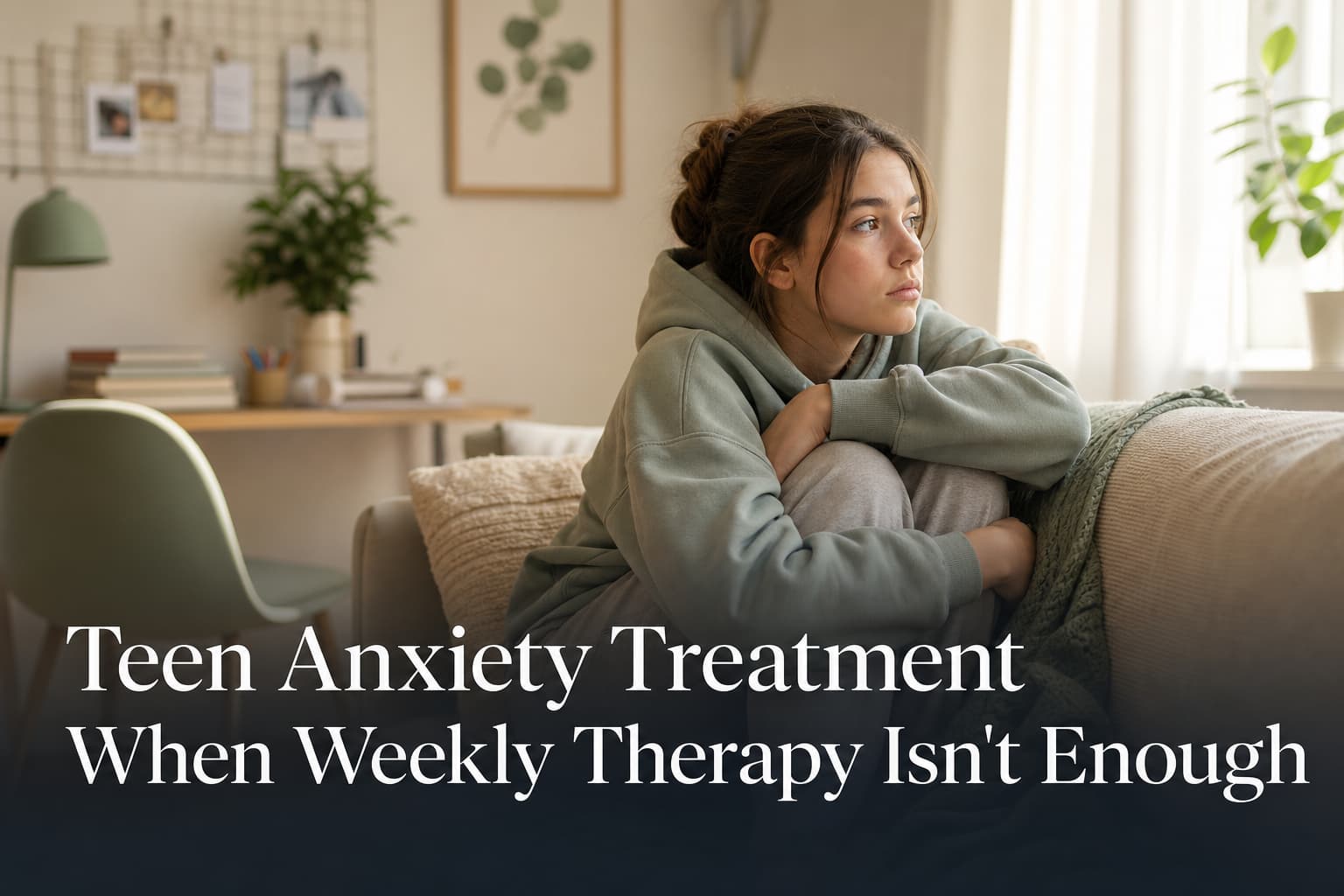
Most weekly therapy slots run 45 to 50 minutes. For a teen who can't finish first period without a panic spiral, that dose often can't keep pace with the rest of the week.
You are not failing as a parent if the once-a-week plan stopped working. Anxiety that drives school refusal, repeated ER-level panic, or total shutdown at home usually needs more structure than a single outpatient hour. Below is when to step up teen anxiety treatment, what virtual intensive outpatient (IOP) and outpatient care actually involve, and how Mental Health For Teens works with families across San Diego and California.
When weekly sessions stop matching the week
Weekly therapy still helps many teens. A 45- to 50-minute slot cannot cover five hard school days. It stops being enough when symptoms grow between sessions faster than skills can stick.
Watch the pattern, not one hard day. Your teen may leave a good session calmer, then spend five days avoiding class, sleeping through mornings, or texting you from the bathroom during tests. Skills taught on Tuesday do not get practiced if Wednesday through Monday are pure survival.
Common ceilings parents report include missed school most weeks, panic that ends activities mid-event, constant reassurance loops at home, and therapy talk that never turns into real-world practice. The National Institute of Mental Health describes how anxiety disorders can interfere with school and daily life when left undertreated. More contact hours give room to rehearse facing fears instead of only talking about them.
If your teen is safer between crises than during them, but still can't function at school or home, intensity is the lever to pull next, not a brand-new diagnosis hunt.
School avoidance and panic need more than insight
School avoidance is often anxiety in motion. The body treats the hallway, the test, or the social lunch table like a threat, so staying home feels like relief. That relief teaches the brain to avoid again tomorrow.
A single weekly hour rarely breaks that loop. Exposure work needs planned steps, same-day coaching, and parent scripts so you are not inventing responses at 7 a.m. when your teen will not get in the car. Panic attacks work the same way. Without repeated practice sitting with body sensations, the next spike still feels like an emergency.
Stepped-up teen anxiety treatment puts exposure and coping drills into the calendar several times a week. You get a shared plan for mornings, attendance goals, and what to do after a panic wave instead of negotiating from scratch each time.
“Avoidance shrinks life fast. Treatment has to expand contact with the feared situation. Explaining why fear shows up is not enough on its own.”
What higher-intensity teen anxiety treatment includes
Outpatient care and virtual IOP sit above weekly therapy in structure. They keep your teen at home. They add hours, group skills, and coordinated family work.
At Mental Health For Teens in San Diego, levels of care include Virtual IOP, Outpatient, online therapy, and family therapy for ages 12–17. Virtual IOP packs multiple clinical touchpoints into the week so CBT tools, exposure steps, and emotion-regulation skills get used while school stress is still fresh. Outpatient offers a lighter step when weekly care is thin but full IOP hours are not required yet.
Expect a mix of individual work, skills groups, and parent sessions. Clinicians track attendance barriers, panic frequency, and avoidance, then adjust the plan. You are not left guessing whether trying harder at home is the assignment.
CBT, exposure, and DBT skills at IOP pace
Evidence-based anxiety care still centers on cognitive behavioral therapy and gradual exposure. Higher intensity changes the dose, not the core idea. Virtual IOP at Mental Health For Teens puts that dose on the calendar several days each week.
CBT helps teens catch threat thoughts and test them against real outcomes. Exposure builds a ladder from easier to harder situations, like sitting through advisory before tackling a full test period. DBT-informed skills add distress tolerance and emotion labeling for the moments when the body floods and logic drops offline.
In virtual IOP, those tools show up several days a week. A teen can practice a brief exposure, debrief the same afternoon, and try again before avoidance resets. Parents learn how to coach without rescuing, which matters when the hardest exposures happen at school drop-off, not on a video call.
No fixed timeline for symptom change gets promised here. Practice gets structured so skills have a chance to stick between crises. For broader youth behavioral health context, SAMHSA's resources for families outline how stepped care and family involvement support recovery-oriented planning.
Virtual IOP for San Diego and California families
Virtual IOP removes the commute while keeping clinical structure. That matters in San Diego traffic and for California families outside easy drive range of a brick-and-mortar program.
Mental Health For Teens serves teens ages 12–17 with virtual intensive programming plus outpatient and online therapy options. Our office is at 7220 Trade St ste 125, San Diego, CA, 92121, and families statewide can start with a remote path when in-person attendance would add another barrier.
Online delivery still requires a private space, reliable internet, and a teen willing to be on camera for groups and individual sessions. If your teen already avoids leaving the house, virtual care can lower the entry barrier. It still asks them to show up on purpose, practice skills, and let parents join family sessions.
If mornings are the meltdown window, ask how the program schedules sessions around school re-entry goals rather than only after the school day collapses.
Family therapy when anxiety runs the household
Anxiety rarely stays inside one bedroom. Parents rearrange work, siblings walk on eggshells, and everyone learns to tip-toe around the next panic.
Family therapy is part of our care mix for a practical reason. Teens need adults who stop over-accommodating fear while still staying warm. That balance is hard to invent alone at 6:30 a.m. Sessions give you scripts for school mornings, limits on reassurance loops, and a shared language so home does not undo clinical work.
You remain the expert on your kid. We bring structure so the whole household is not organized around avoidance.
Outpatient versus virtual IOP: how parents choose
Choose virtual IOP when symptoms disrupt school or home most days and weekly therapy has not slowed the slide. Choose outpatient when your teen can still attend most classes, use some skills between sessions, and needs more than one hour without full intensive scheduling. Mental Health For Teens offers both paths for California teens ages 12–17.
A simple filter helps. If panic or refusal cancels plans several times a week, step up. If progress stalled but life is mostly intact, denser outpatient or online therapy may be enough. Safety crises, active self-harm risk, or medical instability need a higher level of care assessment than IOP alone can cover. The CDC's youth mental health guidance stresses getting the right level of support early when functioning drops.
Bring specifics to any consult: days of school missed this month, panic frequency, sleep collapse, and what weekly therapy already tried. Vague descriptions slow matching. Concrete patterns speed it up.
Questions Readers Ask
How do I know weekly therapy isn't enough for my teen's anxiety?
Weekly therapy is not enough when avoidance, panic, or school refusal keep expanding between sessions despite solid attendance with a licensed clinician. If skills never transfer to mornings, hallways, or tests, intensity usually needs to rise.
What is virtual IOP for teen anxiety treatment?
Virtual IOP is a structured online program with multiple clinical sessions each week, often mixing groups, individual work, and family therapy while your teen lives at home. Mental Health For Teens offers Virtual IOP as one level of care alongside outpatient and online therapy.
Can my teen keep going to school during IOP?
Many teens use IOP while working a school re-entry plan, partial schedule, or attendance rebuild with the campus. The clinical team should coordinate goals with you so treatment hours support return-to-class steps instead of replacing them forever.
Does family therapy mean we caused the anxiety?
No. Family therapy targets the patterns that grow after anxiety arrives, like over-accommodation and conflict cycles, so home life supports exposure and skills. Parents are partners in treatment, not the diagnosis.
How fast can California families start with Mental Health For Teens?
Most families start within a few days after a free confidential consultation. Call 619-354-3569 or book through the site to review fit for Virtual IOP, outpatient, online therapy, or family therapy.
Is virtual care appropriate if my teen hides in their room all day?
Virtual care can lower the barrier to first engagement when leaving home feels impossible, but your teen still needs enough willingness to log on, participate, and practice between sessions. A consult can sort whether virtual IOP, outpatient, or another path fits that starting point.
Book a free consultation
If weekly therapy cannot keep up with school avoidance or panic, step up the structure before another month of missed days piles on. Mental Health For Teens offers Virtual IOP, outpatient, online therapy, and family therapy for teens 12–17, with free confidential consultations and most families starting within a few days.
Book a free consultation at https://mentalhealthforteens.com/#start or call 619-354-3569. We're at 7220 Trade St ste 125, San Diego, CA, 92121, and we work with California families who need a clear next level of teen anxiety treatment without guessing alone.
Written by
Mental Health For Teens
Clinical TeamVirtual IOP and outpatient mental health programs for teens in San Diego and across California.