
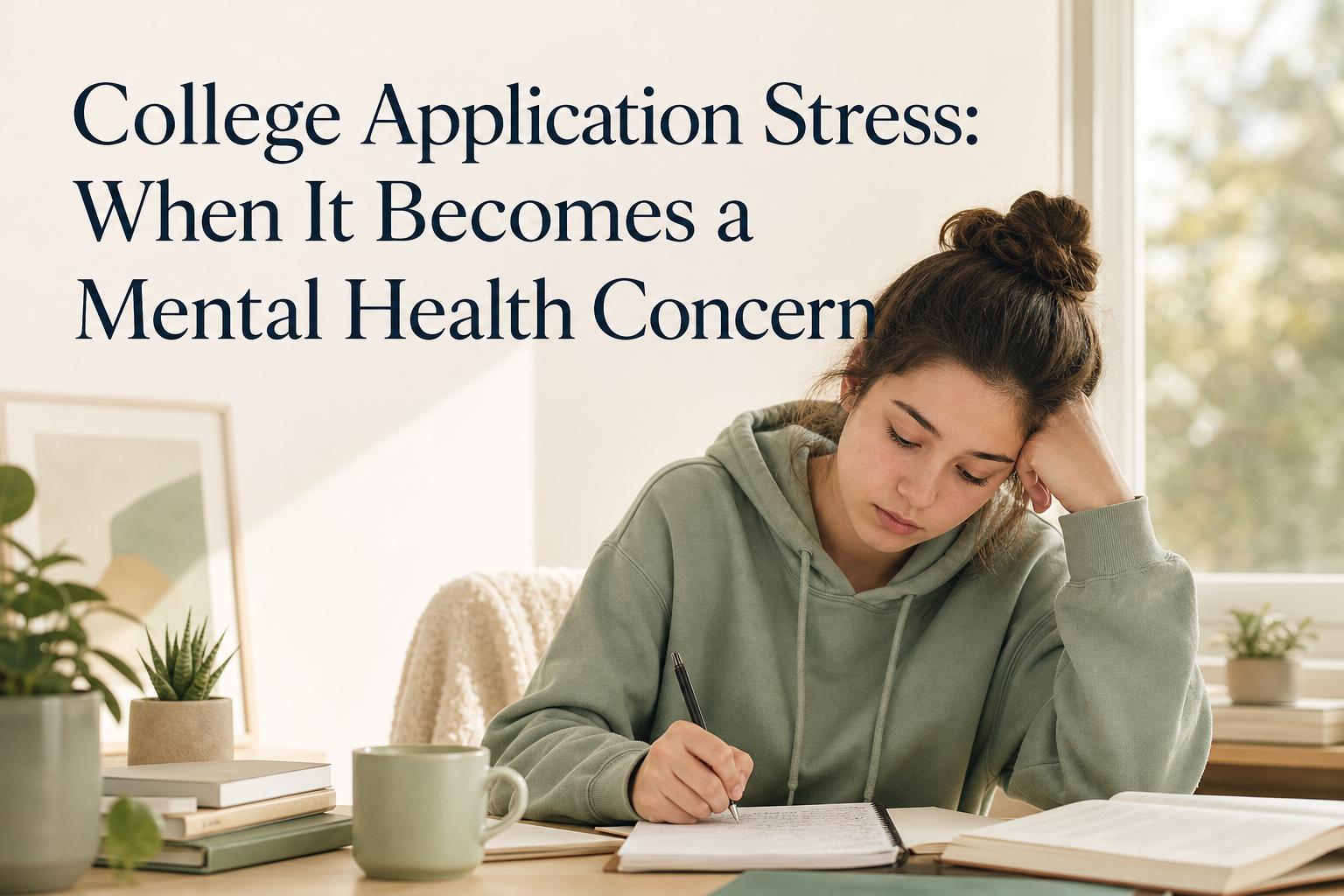
Some college application stress is expected, but sleep loss, panic, hopelessness, or pulling away from friends that lasts for weeks is a reason to ask a clinician for an opinion. A teen who's tired and irritable the week an essay is due is usually reacting to a heavy workload. A teen who's still struggling a month later, even after the deadline passes, may need more than reassurance from you.
If you or someone you love is thinking about suicide or self-harm, call or text 988 any time, day or night. You can also chat with a trained crisis counselor at [988lifeline.org](https://988lifeline.org).
What Normal College Application Stress Looks Like
Expected stress in application season rises and falls with the workload. A teen gets tense before an essay draft is due, snaps at a sibling after a long night of revising, and then settles once the pressure eases. You'll often see worry about test scores, comparisons with friends who are further along, and a few restless nights. Those reactions are uncomfortable, but they usually track a specific task and loosen when it's finished, often within a few days of a submission.
Normal stress also leaves room for the rest of your teen's life. They may complain about supplemental essays and still laugh at dinner, text friends back, show up to practice, and eat and sleep close to their usual patterns. A bad day is followed by a better one, and a reassuring conversation actually helps for a while.
Four questions can help you sort what you're seeing:
- Does the mood lift when a deadline passes or a task is submitted?
- Is your teen still doing things they enjoyed before application season?
- Are sleep and appetite mostly steady, apart from a rough night here and there?
- Can your teen talk about the stress, even if they grumble about it?
If most answers are yes, you're likely watching ordinary strain. Your teen probably doesn't need treatment, and weekly therapy is the right level of care for many teens who want extra support. A clinician makes any diagnosis, so these questions are a way to organize what you've noticed, not a screening result.
When you start answering no to several of them, and the change has lasted for weeks instead of days, that's the point to look more closely. The next section covers the specific signs that separate heavy pressure from anxiety or depression.
Signs of Anxiety or Depression Instead of Normal Stress
Sleep loss that continues for weeks, panic that shows up outside of schoolwork, and a flat or hopeless mood that doesn't lift after a submission are the patterns that point toward anxiety or depression rather than ordinary strain. The National Institute of Mental Health notes that anxiety and depression in young people can look like irritability, withdrawal, or physical complaints, so the signs don't always sound like sadness or worry.
Here are the changes worth writing down, with dates if you can:
- Trouble falling asleep, waking in the early morning, or sleeping much more than usual, for several weeks
- Panic symptoms such as a racing heart, shortness of breath, or crying spells that come on without a clear trigger
- Statements like "nothing matters" or "I'll never be good enough," especially when they continue after good news
- Pulling away from friends, skipping activities they used to enjoy, or staying in their room most of the evening
- Frequent headaches or stomachaches, or big shifts in appetite
- Dropping grades or missing school, even though the applications are mostly done
Several of these together, lasting weeks, matter more than any single bad night. Hopeless talk deserves attention right away, and a clinician can help you decide how urgent it is.
Only a clinician can tell you whether this is anxiety, depression, or something else. What you can do is bring your notes to a consultation, because specifics like "awake until 3 a.m. for five weeks" help far more than "he seems off." If you want more background on how teen anxiety is treated, our page on teen anxiety treatment explains it, and teen depression treatment covers low mood. If your teen seems drained more than afraid, our post on emotional exhaustion in teens describes how that differs.
A clinician looks at safety, daily functioning, and the support your teen has at home before suggesting a level of care. A diagnosis alone doesn't decide it, and more hours of treatment aren't automatically better.
Selected references
National Institute of Mental Health, Child and Adolescent Mental Health
Ways Parents Can Lower the Pressure at Home
Start by changing what you ask about at dinner, because "Did you finish the essay?" turns every conversation into a progress report. Try asking how your teen's day went, and save application logistics for one set time, say twenty minutes on Sunday afternoon, so the topic doesn't follow them from room to room.
Next, look at the signals your teen picks up from you. Comparing them to cousins or neighbors' kids, or reacting to each rejection or acceptance with visible disappointment or relief, teaches them that your mood depends on their results. Saying "I'm proud of how you're handling this, whatever comes back" gives them something steadier to rely on.
Protect the basics too. A teen who is cramming essays until 2 a.m. will feel more anxious and more hopeless, so agree on a cutoff time for applications and keep one evening a week free of them. Meals, movement, and time with friends keep the workload tolerable, so they shouldn't be treated as rewards for finishing.
It also helps to widen the picture of what comes next. Mentioning that there are several good paths after high school can ease the sense that one decision defines your teen's future. You don't need to argue the point, and saying it once, calmly, is enough.
If the tension at home has become part of the problem, family support can help. At Mental Health For Teens, family therapy and parent coaching are built into both levels of care rather than billed as add-ons, so you'd learn how to respond to your teen's stress alongside their own sessions. Teens also get confidential individual time, and you receive plain-language progress updates, with the limits of confidentiality explained up front.
Lowering the pressure at home often brings relief within days. If your teen's sleep, mood, or withdrawal hasn't improved after a few weeks of this, that's your cue to ask a clinician for an opinion rather than try harder on your own.
How Evening Virtual Care Fits Around a Senior Schedule
Sessions run Tuesday, Wednesday, and Thursday at 5, 6, and 7 pm PT, so your teen can finish the school day, practice, or a shift before logging on from home. Nothing about the schedule requires a drive across town, which matters when your teen is already losing hours to essays and test prep.
In virtual IOP, teens typically spend about 9 to 12 clinical hours a week in group, individual, and family therapy, with CBT and DBT skills built in. Exact time slots are set with your family at intake, and start dates are arranged around school. That gives you room to mention a heavy week of supplemental essays or an upcoming interview before the schedule is locked in.
The outpatient program is lighter, with one to three sessions a week in the same evening windows and a consistent individual therapist. Many seniors with anxiety or low mood begin there. A clinician recommends IOP only when that level of structure fits your teen, and IOP steps down to outpatient when symptoms, functioning, and safety support it. Our post on how virtual IOP fits around school schedules walks through a typical week, and the outpatient program for teens page describes the lighter option.
Because care is secure video, your teen needs to be physically in California during sessions and have a private space at home where they can talk openly. A bedroom with the door closed and headphones on usually works. If a shared house makes that hard, raise it during your consultation so the team can plan around it.
Your teen doesn't have to give up evenings for school work entirely, either. Many families agree on a firm stopping point for applications on session nights, which protects both the therapy hour and sleep. If your teen's school needs documentation, coordination letters are available on request, though enrollment doesn't create a 504 plan or IEP.
Choosing a Level of Care and Starting a Consultation
A clinician picks between outpatient and virtual IOP by weighing three things: your teen's safety, how well they're functioning day to day, and how much support they have at home. A diagnosis alone doesn't settle it. A senior who's sleeping poorly and dreading school but still attending, eating, and talking with you often fits outpatient. A teen who has stopped functioning across school, friendships, and home may need the added structure of IOP. The level can change in either direction as your teen's needs change.
The consultation is free and confidential, and you aren't obligated to enroll. A parent or legal guardian completes the consultation and enrollment steps, so plan to be the one on the call. It helps to have your notes ready, including sleep changes with dates, any panic episodes, comments like "nothing matters," and changes in grades or attendance. Mention your teen's current schedule too, such as practice, a job, or interview dates, along with any existing therapist or psychiatrist. Some teens keep their current psychiatrist, and medication decisions stay with the licensed prescriber.
Before enrollment, we verify your insurance benefits and explain your estimated out-of-pocket costs in plain language. Benefits vary by plan, and coverage and authorization depend on medical necessity. Ask us about reimbursement paperwork.
We also screen for safety, the home environment, and acuity. If home-based care isn't the right fit, for example when a teen is in active suicidal crisis without a safety plan, we'll refer your family to in-person or higher levels of care. Mental Health For Teens doesn't provide emergency or crisis response, so in an emergency call 911, or call or text.
When you're ready, request a free, confidential consultation. Start dates are set around your teen's school schedule at intake, so bring your questions about evenings, essays, and anything else that's crowding the calendar.
Written by
Mental Health For Teens
Clinical TeamVirtual IOP and outpatient mental health programs for teens in San Diego and across California.