
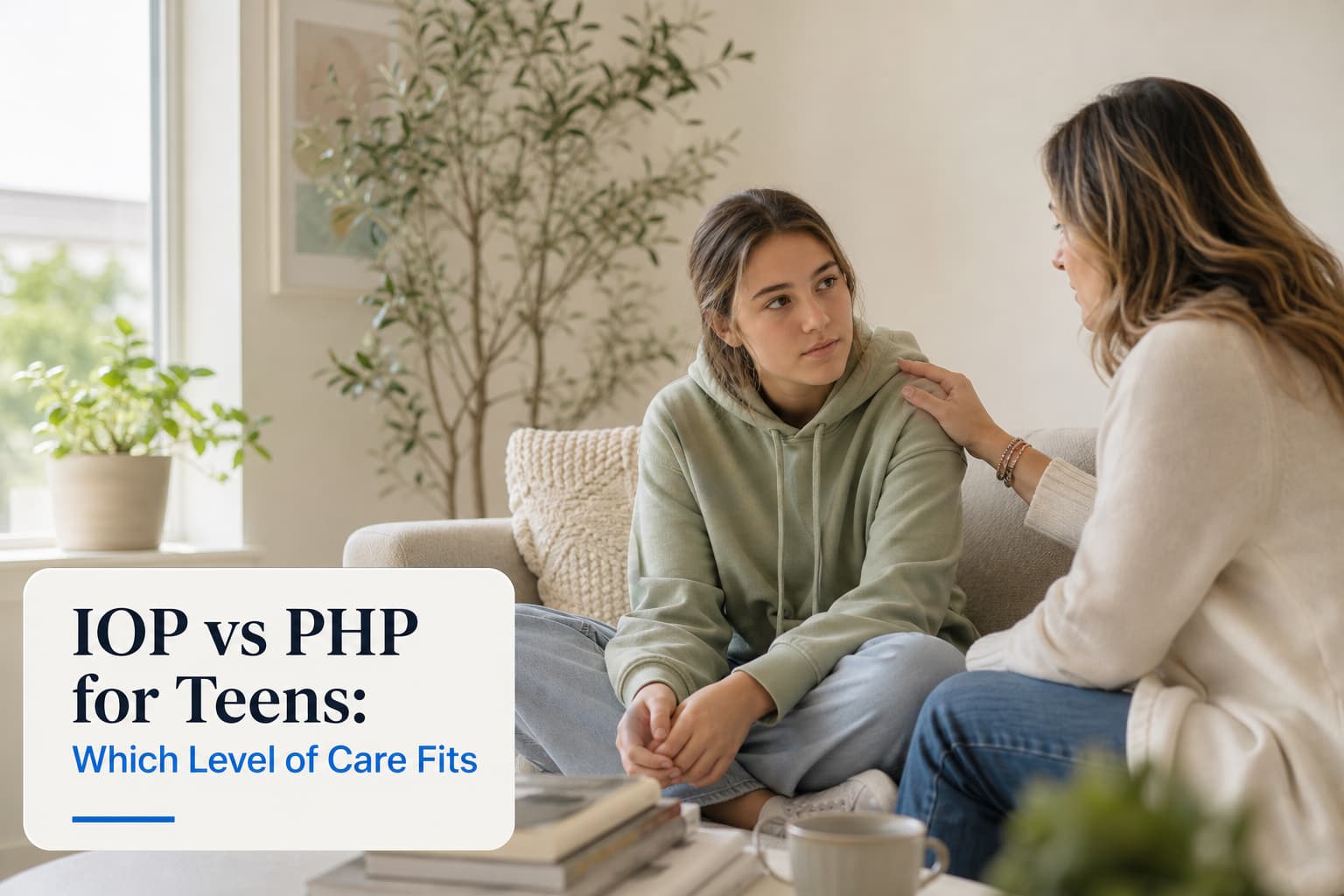
Wrong intensity costs time. A teen who needs more than weekly therapy can stall for weeks in care that is too light, or lose school and home routines in a placement heavier than the risk requires. IOP vs PHP for teens is usually the first fork parents hit. Residential sits above both when overnight safety will not hold at home.
This guide sorts the three levels by structure, safety boundaries, and real fit. Mental Health For Teens provides virtual IOP, outpatient, online therapy, and family therapy in San Diego and across California. We do not run PHP or residential. When a higher level is the honest answer, we say so and help you move that way.
What IOP, PHP, and residential mean in practice
These labels describe intensity and setting. They do not rank how “serious” your teen is as a person. Residential means overnight care in a facility with 24-hour staffing. Your teen lives there for a defined stay while school and home life pause or shift around the program.
Partial hospitalization (PHP) is day treatment. Teens usually attend many hours per day, most weekdays, then return home at night. It sits between residential and IOP on the intensity ladder used across behavioral health.
Intensive outpatient (IOP) keeps teens at home and in regular school when that is safe. Sessions cluster several days a week for a few hours each day, often with group therapy, individual work, and family sessions. Virtual IOP delivers that same structure online when the clinical picture allows it.
The Substance Abuse and Mental Health Services Administration (SAMHSA) describes a continuum of care for a reason. You match the setting to risk and daily function, then step down as stability returns. You do not start at the top to feel thorough.
Safety boundaries that point to residential first
Start with safety, not preference. Residential is the right first look when your teen cannot stay safe overnight at home, even with close supervision. Active plans for suicide, recent attempts, inability to contract for safety, or aggression that puts household members at risk belong in a higher-level conversation now.
Call 911 for immediate danger. For a mental health crisis in the United States, dial or text 988 to reach the 988 Suicide & Crisis Lifeline. Those lines exist for this exact moment. A level-of-care guide is not a substitute for emergency response.
Medical instability also changes the map. Severe restriction with rapid weight loss, withdrawal risk that needs monitoring, or psychosis with poor reality testing often needs continuous clinical coverage. PHP and IOP assume your teen can sleep at home without a safety collapse between sessions.
If you are unsure whether tonight is safe at home, treat that uncertainty as data. Seek urgent evaluation before you shop programs by schedule or insurance alone.
When PHP fits better than IOP
PHP fits teens who are medically and behaviorally stable enough to leave at night, yet still need near-daily structure that IOP cannot supply. Major depressive symptoms that block school attendance, acute anxiety with panic that has not responded to weekly care, or a recent step-down from inpatient or residential who still needs a full clinical day are common examples.
Hours are the practical difference. PHP often fills most of a school day, several days a week. IOP typically runs fewer hours and fewer total contact points. If your teen unravels every afternoon the moment structure ends, PHP’s longer day can hold the pattern while skills catch up.
PHP still depends on a workable home. If evenings include unrestricted access to means of self-harm, substance use in the house, or caregivers who cannot supervise, the go-home-at-night model fails. Fix the home plan or step up. Do not hope the day program will outrun an unsafe night.
We do not operate PHP at Mental Health For Teens. If a clinical assessment points there, the useful next move is a PHP referral, not a softer IOP pitch that under-serves the risk.
When IOP vs PHP for teens lands on IOP
Choose IOP when symptoms are real and impairing, safety holds at home, and your teen can still manage parts of school or a modified schedule. Depression, anxiety, OCD, trauma-related symptoms, and emerging substance use often fit here when risk is monitored and caregivers stay engaged.
IOP works when the gap is skill and consistency, not constant containment. Your teen needs repeated practice with coping tools, peer group process, and family sessions that change how conflict runs at home. Weekly therapy alone has not been enough. Full-day PHP would pull them out of life more than the clinical picture requires.
Virtual IOP is a strong option when travel would block attendance or when your teen engages better on screen in a private space. It is not a workaround for high-risk teens who need eyes-on staffing. Same clinical rules apply. Safety first, then format.
Mental Health For Teens offers virtual IOP and outpatient care for ages 12–17, plus online therapy and family therapy. Families in San Diego can reach the team at 619-354-3569 or visit 7220 Trade St ste 125, San Diego, CA 92121. Most families who book a free consultation start within a few days when IOP or outpatient is the right fit.
A simple decision path parents can actually use
Run the questions in order. Do not skip ahead to which program has the nicest brochure.
First, is your teen safe at home overnight with a clear plan and means restricted? If no, seek urgent or residential-level evaluation and use 911 or 988 as needed. Second, can they return home each evening and still make it through the night without crisis? If no, residential or inpatient review comes before PHP or IOP. Third, do they need most of a clinical day, most weekdays, to stabilize mood, behavior, or school refusal? If yes, PHP is the better match than IOP. Fourth, are symptoms impairing but manageable with several structured sessions per week while living at home? IOP is the usual answer. Fifth, is standard weekly therapy enough and is function mostly intact? Outpatient or online therapy may be the right start without intensive programming.
Insurance language can blur these lines. An authorization for PHP on a portal does not override a safety problem at 2 a.m. Clinicians still assess risk, supports, and daily function. Ask any program how they handle after-hours crisis, step-up criteria, and discharge planning before you enroll.
The National Institute of Mental Health notes that youth mental health conditions are treatable and that early, appropriate care matters. Appropriate includes intensity. Too little care wastes months. Too much care can disrupt school and family life without a matching clinical need.
How family involvement changes the level you pick
Caregiver capacity is part of the clinical picture. PHP and IOP both send teens home. Someone has to supervise medication, limit harmful online spaces, get them to sessions, and respond if mood drops after group. If that bench is thin, a polished IOP schedule still fails.
Family therapy is not window dressing. Patterns at home often maintain anxiety, depression, or conflict. When parents learn the same skills the teen practices in group, gains stick. Mental Health For Teens includes family therapy among its levels of care for that reason.
If your household cannot support evenings after PHP, say that out loud in the assessment. The honest fix might be short-term residential, in-home supports, or a different caregiver arrangement, not a quieter version of the same plan.
“Match the level to overnight safety and daytime function. Preference and commute come after that.”
What we offer and what we refer out
Mental Health For Teens focuses on virtual IOP, outpatient, online therapy, and family therapy. That scope is deliberate. Parents searching IOP vs PHP for teens deserve a straight answer when PHP or residential is indicated, not a funnel into the only product on the shelf.
In a free confidential consultation, we sort fit. If virtual IOP matches the risk profile and your teen’s schedule, we outline how care starts. If the picture points higher, we say so. You leave with clarity either way.
For background on how intensive outpatient is generally defined in behavioral health standards, the American Society of Addiction Medicine (ASAM) continuum is a widely used reference frame even when the primary issue is mental health rather than substance use alone. Ask any program where they sit on a continuum and how they step teens up or down.
Frequently Asked Questions
Is PHP the same as inpatient for teens?
No. Inpatient and residential involve overnight stays with 24-hour staffing. PHP is day treatment. Teens go home at night when that is clinically appropriate.
Can a teen start IOP and move up to PHP later?
Yes. Levels of care are meant to change with risk and function. If symptoms worsen or safety thins, the team should step up rather than wait for a full crisis.
Does virtual IOP work if my teen is in crisis?
Virtual IOP is for teens who are stable enough to live at home between sessions. Active crisis needs 911, 988, or an urgent in-person evaluation, not a telehealth intensive schedule alone.
How do I know school can continue during IOP?
Many teens keep a full or modified school day because IOP hours are shorter than PHP. Confirm session times with the program and loop in the school counselor early so attendance plans stay realistic.
What if we live in California but outside San Diego?
Mental Health For Teens serves families seeking virtual IOP and outpatient mental health care across California, with a San Diego office at 7220 Trade St ste 125. A free consultation can confirm whether virtual care is available for your location and clinical needs.
Should we choose the highest level insurance will approve?
No. Choose the least intensive level that still keeps your teen safe and produces real clinical contact. Higher is not automatically better, and lower is wrong when overnight safety is in doubt.
Book a free consultation
Free confidential consultations. Most families start within a few days when virtual IOP or outpatient is the right level. Call 619-354-3569 or book a free consultation at https://mentalhealthforteens.com/#start. If someone is in danger right now, call 911 or contact 988 before you do anything else.
Written by
Mental Health For Teens
Clinical TeamVirtual IOP and outpatient mental health programs for teens in San Diego and across California.