

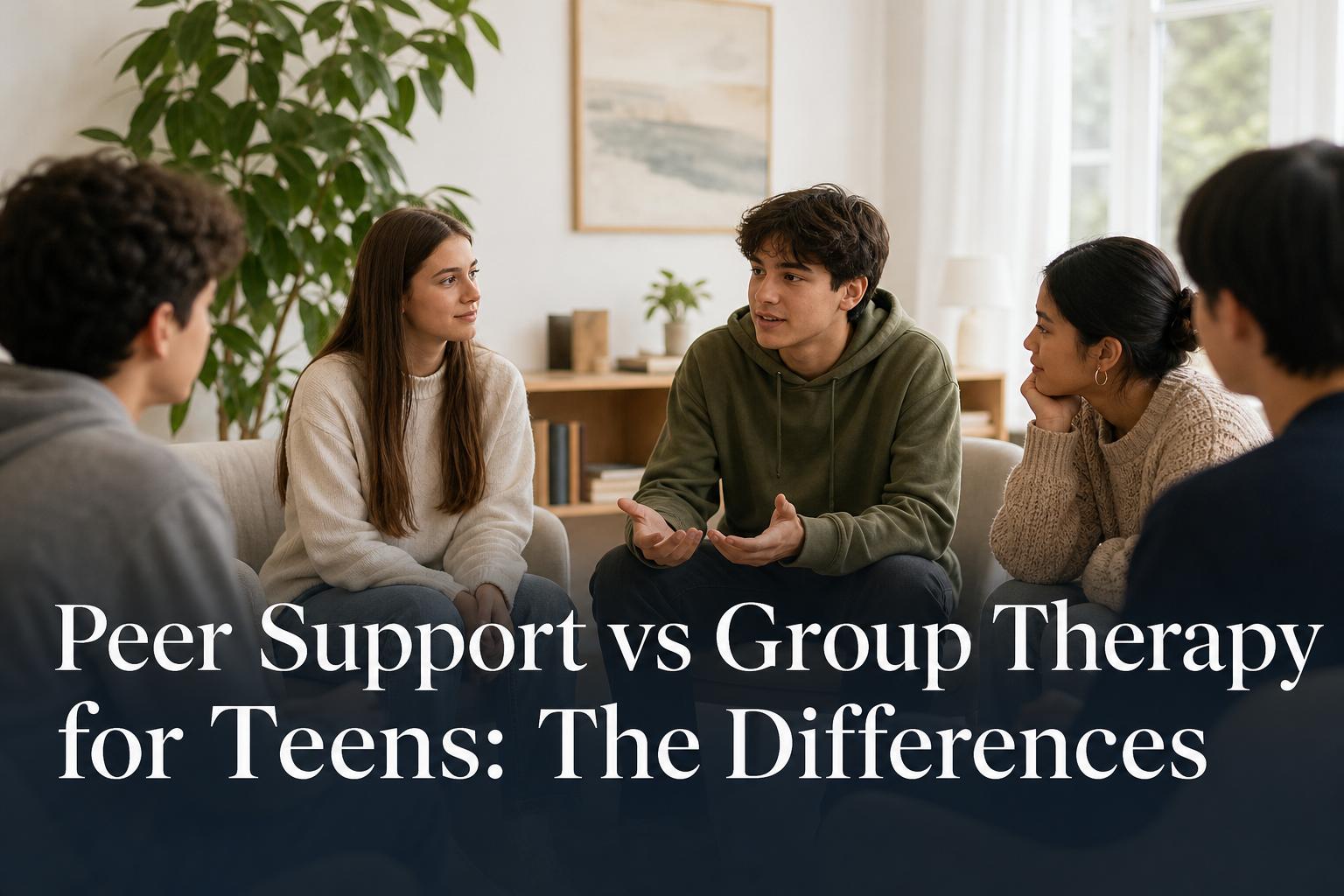
In the peer support vs group therapy teens question, the main difference is who leads the room. Peer support groups are run by other teens or trained volunteers and offer connection, while group therapy is run by a clinician who follows a treatment plan and teaches skills like CBT and DBT. Both can help a teen feel less alone, but they do different jobs.
Peer Support vs Group Therapy for Teens: Who Leads and Why It Matters
The person at the front of the room decides what a group can safely do, so it's the first thing to ask about when you compare options. A peer support group runs on shared experience. The facilitator may be another teen or a trained volunteer, and the conversation follows whatever members bring that day. Nobody in that role is assessing your teen, writing a treatment plan, or adjusting care when symptoms change.
A clinician-led therapy group works differently because the leader is responsible for clinical decisions. At Mental Health For Teens, groups are clinician-led and sit inside a larger plan for each teen. In virtual IOP, that means skills groups where CBT and DBT are taught on purpose, with diary card review as part of the DBT work. The clinician notices when a teen goes quiet, when a topic is stirring up too much, and when it's time to follow up one-on-one or bring in the family.
That responsibility changes what you can expect from each format:
- **Structure:** Peer groups are usually open-ended conversation. Therapy groups have a plan, a skill to practice, and a reason for each session.
- **Oversight:** A therapy group leader tracks how your teen is doing across mood, sleep, school, and safety. A peer facilitator isn't trained or positioned to do that.
- **Purpose:** Peer support offers understanding from people in a similar spot. Group therapy treats symptoms and builds coping skills your teen can use at home and at school.
Neither format is better in every case. A teen who mainly needs to hear "me too" has different needs from a teen whose anxiety or low mood is interfering with school and family life, and the leader's training is what separates the two.
What a Teen Peer Support Group Looks Like
Most peer support groups meet on a regular schedule, and the session usually opens with a check-in where each teen shares as much or as little as they want. From there, the conversation follows what members bring. One teen might talk about a rough week at school, another about a fight with a parent, and the group responds with its own stories. There's rarely a worksheet, a skill to practice, or homework before the next meeting.
The facilitator keeps things respectful and moving. In some groups that's an older teen or young adult who has been through something similar, and in others it's a trained volunteer. Their training is typically in listening and group norms, not in assessing symptoms or treating a condition. Because the focus is shared experience, teens often say it feels easier to talk there than at home, since nobody in the room is trying to fix them.
Before your teen joins, a few questions will tell you what you're dealing with:
- Who facilitates, and what training did they receive?
- Is the group open to new members each week, or closed to a set cohort?
- What happens if a teen says something that worries the facilitator?
- Do parents hear anything about attendance or what was discussed?
Peer groups can be a good fit as a place to feel understood, but they don't replace treatment for a teen whose symptoms are affecting sleep, school, or safety. If you're unsure which describes your teen, our guide to signs your teen needs therapy can help you decide whether to ask a clinician for a closer look.
What Clinician-Led Group Therapy Looks Like at Mental Health For Teens
Group therapy at Mental Health For Teens happens on video, after the school day, so your teen joins from a private space at home. Virtual IOP sessions run Tuesday, Wednesday, and Thursday at 5, 6, and 7 pm PT, and the family and clinical team set your teen's exact time slots at intake. Typical IOP involves about 9 to 12 clinical hours a week, and group therapy is one part of that time alongside individual and family sessions.
A session has a purpose before anyone logs on. The clinician picks a skill from CBT or DBT, teaches it, and then asks teens to try it on a real situation from their week, such as a hard conversation with a parent or a spike of anxiety before a test. In DBT work, teens also review their diary cards, the daily record of emotions and skill use, so the clinician can see what's working and what isn't. Other methods in the program, including ACT, mindfulness, and art therapy, can be part of the plan as well.
The group doesn't stand alone. The same clinical team tracks mood, sleep, school, and safety through check-ins and symptom measures, and a teen who is struggling in group can get more attention in an individual session. Parents receive plain-language progress updates and take part in family therapy and parent coaching, which are built into care.
Some teens need time before they speak up, and the clinician plans for that. Our post on how virtual IOP programs handle teens who don't engage in group explains what that looks like, and you can read a step-by-step account of a virtual IOP group session if you want to picture the hour. Our group therapy page covers the format in more detail.
How Confidentiality and Safety Work in Each Format
Confidentiality in a peer support group depends almost entirely on the group's own ground rules, because nobody in the room is bound by a professional duty to keep what's said private. Most groups ask members to keep stories inside the room, but that's a request, not a guarantee, and teens can repeat things to classmates or online. If your teen is considering one, ask the facilitator how the group handles a member who shares something worrying, and whether parents are ever told.
Clinician-led group therapy runs on clearer terms. At Mental Health For Teens, teens have confidential individual time, and the safety limits on that confidentiality are explained up front, before your teen shares anything. In practice, that means your teen knows ahead of time which situations the clinical team would need to act on, such as a risk to your teen's safety. Parents get plain-language progress updates instead of session transcripts, so you stay informed without your teen feeling watched.
Safety planning is another real difference. Because our sessions happen by secure video, your teen needs a private, safe space at home and has to be physically in California during sessions. The clinical team screens for safety, home environment, and acuity before care begins. If home-based care isn't appropriate, such as when a teen is in active suicidal crisis without a safety plan, the team refers your family to in-person or higher levels of care.
Mental Health For Teens doesn't provide emergency or crisis response, and a peer group usually doesn't either. For that reason, you'll want a plan for urgent moments that doesn't depend on either format. Our crisis resources page lists where to turn.
Which Teens Fit Peer Support and Which Fit Group Therapy
A teen who is sleeping and eating normally, keeping up with school, and mostly needs to talk with people who've had similar experiences is usually a fit for peer support. Think of a teen adjusting after a move, a friendship breakup, or a hard season at home, who still has a working daily routine and a parent they can talk to. In that situation, a peer group adds connection without needing a treatment plan behind it.
Group therapy fits when symptoms are getting in the way of daily life. Missed school, panic before tests, intense anger at home, self-harm concerns, or low mood that doesn't lift are all reasons to ask a clinician about a therapy group. Teens who need to learn specific skills, like how to ride out a surge of emotion without lashing out or shutting down, benefit from a leader who teaches those skills and checks whether they're working.
Your teen's diagnosis doesn't settle the choice. A clinician weighs safety, daily functioning, and how much support your teen has at home. That's also why more hours aren't automatically better. At Mental Health For Teens, a clinician recommends virtual IOP only when that intensity fits, and some teens do well with the lighter outpatient program, which offers one to three sessions a week with a consistent individual therapist.
Personality matters too, though it shouldn't be the deciding factor. A shy teen may warm up faster in a peer group. A teen with social anxiety may still need clinician-led work, because the leader can pace exposure to speaking up instead of leaving it to chance. Our post on online therapy versus group IOP for teen social anxiety walks through that comparison.
If you can't tell which description fits, a free, confidential consultation lets a parent or guardian talk through what you're seeing, and the level of care can change later if your teen needs more or less structure.
Using Peer Support and Group Therapy Together
Yes, a teen can attend a peer support group while also taking part in clinician-led therapy, and the two usually work best when the treatment team knows about both. Peer support gives your teen a place to be understood without a plan attached. Therapy groups and individual sessions handle the symptoms and the skills. Telling the clinician about an outside group lets them watch for anything that comes up there and help your teen practice skills in that setting.
A few practical points make the combination smoother:
Tell your teen's clinician which peer group your teen attends, how often it meets, and who facilitates it.
Ask your teen what they take from each space. Some say the peer group is where they talk freely, while the therapy group is where they learn what to do with a hard moment.
Watch for changes after a peer session, such as a low mood that lingers, and mention them at your next progress update.
Keep evening schedules realistic. Virtual IOP runs Tuesday, Wednesday, and Thursday at 5, 6, and 7 pm PT, so an outside group that meets those evenings may need a different night.
Peer support shouldn't be asked to carry what treatment is built for. If your teen's symptoms are affecting sleep, school, or safety, the clinical team can recommend virtual IOP or the lighter outpatient program, and the level can change as your teen needs more or less structure.
To talk through what your teen is already doing and what might be missing, request a free, confidential consultation at Mental Health For Teens, or call 619-354-3569. A parent or legal guardian completes the consultation and enrollment steps, and start dates are set around your teen's school schedule at intake.
Written by
Mental Health For Teens
Clinical TeamVirtual IOP and outpatient mental health programs for teens in San Diego and across California.