
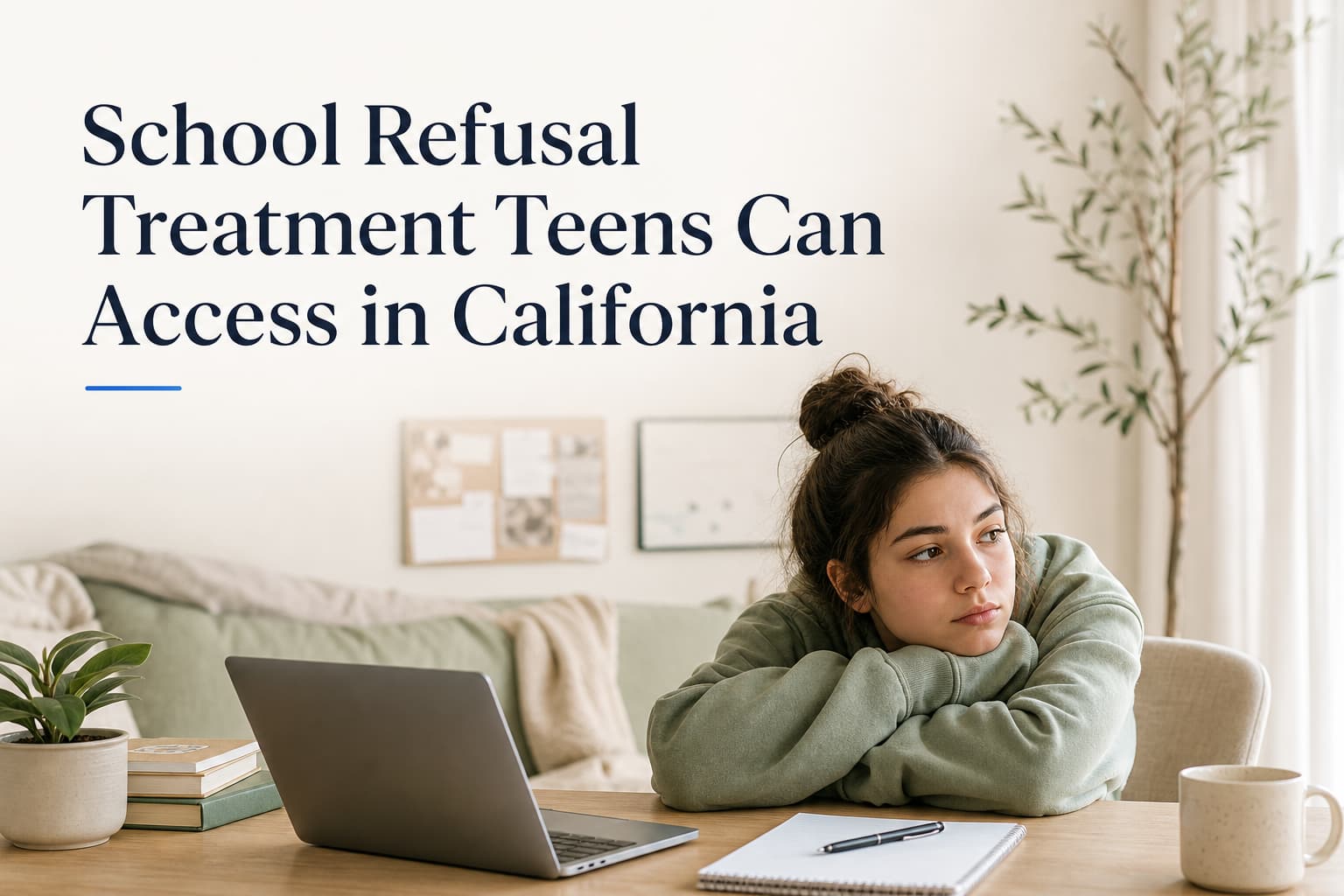
Two weeks of empty desks and unanswered teacher emails usually point to anxiety or depression, not a kid who simply will not try. Your teen will not leave the house. That is clinical. School refusal treatment teens receive should match that reality. At Mental Health For Teens, we treat the mood and anxiety drivers behind avoidance. Virtual care is an option so families across California skip a daily clinic drive through San Diego or farther.
What school refusal looks like at home
School refusal is repeated, distress-driven nonattendance. Mental Health For Teens hears this pattern in California intakes for Virtual IOP and outpatient care from our San Diego office at 7220 Trade St ste 125. Your teen may freeze at the door. Fear runs the morning. They may report stomach pain with no clear medical cause, sleep through alarms after late-night rumination, or melt down when you mention campus. Mornings, tests, social settings, or the full school day are where the pattern clusters.
This differs from skipping for fun with friends. Refusal usually pairs with fear, low mood, or panic. Parents often see a teen who wants to succeed on paper yet cannot complete the steps to get there. That gap is the clinical target.
We are a clinical mental health program, not a school district attendance service. Anxiety, mood, and related symptoms that block school are the focus of care here. IEP meetings, truancy officers, and campus discipline processes stay with the district.
Why anxiety and mood shut school down
Avoidance works in the short term. Staying home cuts the spike of panic, social threat, or hopelessness. Home starts to equal safety. The next morning gets harder. Over days, that loop can erase routines, friendships, and academic credit. Families who call 619-354-3569 often describe this exact slide.
Common drivers include social anxiety, generalized worry, panic, depression, trauma responses, and sleep collapse after late-night phone use. The National Institute of Mental Health describes how anxiety disorders raise avoidance of feared situations. School packs many of those situations into one day for a lot of teens.
Pushing harder without treating the driver often backfires. Lectures, grounding, or taking away privileges can raise shame while the fear system stays in charge. Treatment aims at the fear and mood symptoms first, then rebuilds attendance in steps you can sustain.
When clinical care fits better than school-only supports
Counselors, 504 plans, and shortened days help many students. They fall short when your teen cannot leave the bedroom, has stopped most peer contact, or shows rising depression, self-harm talk, or panic that blocks basic routines. At that point you need a mental health level of care, not another schedule tweak alone.
A clinical fit means symptoms are the main barrier. Your teen may still care about grades. A favorite teacher may still matter. The morning sequence still fails. That is when outpatient therapy, family therapy, or a virtual intensive outpatient program (IOP) belongs on the table.
The Substance Abuse and Mental Health Services Administration outlines how youth mental health care pairs assessment with the right intensity of support. Intensity should match how stuck the avoidance has become, not how frustrated the adults feel.
School refusal treatment teens can start without the commute
For many California families, the clinic drive is part of the problem. A teen who already refuses school may also refuse the car ride to a waiting room. Virtual care removes that friction. Your teen can begin treatment from a familiar room while you stay involved from home or work.
Mental Health For Teens offers Virtual IOP, outpatient care, online therapy, and family therapy from our San Diego office at 7220 Trade St ste 125, with virtual reach across California. Those levels let you match structure to severity. Mild avoidance with solid sleep may start with online therapy. Multi-week collapse, panic, or major mood symptoms may need Virtual IOP for more hours and skill practice each week.
Virtual does not mean casual. Sessions still target exposure steps, emotion regulation, cognitive patterns, and parent coaching. The difference is logistics. You keep treatment inside the week you already have, instead of stacking traffic onto a fragile morning.
“If the car ride to campus already fails, the car ride to a clinic often fails too. Start care where your teen will actually show up.”
How Virtual IOP and outpatient care rebuild attendance
Return-to-school plans fail when they jump from zero days to full days overnight. Clinical work at Mental Health For Teens breaks the return into graded steps tied to skills your teen can use under stress. That might mean logging on for one class, sitting in the parking lot, attending a preferred period, or completing morning hygiene before any campus talk. Small steps beat big leaps. Most families who call 619-354-3569 start within a few days after consult.
In Virtual IOP, teens get a higher weekly dose of therapy than standard outpatient. Density matters here. Avoidance can take over a household fast. Outpatient and online therapy fit when symptoms are real but your teen can still engage a few sessions per week and practice between them. We help you choose intensity based on function at home, not on a single bad morning.
Family therapy sits beside individual work for a reason. Parents often become the only buffer between the teen and total isolation. You need clear scripts for mornings, limits that do not turn into daily wars, and a shared plan with the school when your teen is ready for contact. We include family therapy so the home system stops accidentally rewarding avoidance.
What California parents should line up before care starts
Gather attendance records, any 504 or IEP notes, recent medical rule-outs for physical symptoms, and a plain list of what mornings look like. Note sleep times, device use, panic peaks, and what has already been tried. That packet speeds a clinical intake and keeps the focus on patterns instead of one dramatic day.
Talk with the school about temporary academic bridges only after you know the treatment plan. Partial credit options, home hospital instruction, or reduced schedules can help. They work best when mental health care is already running. Care first, paperwork second, when symptoms drive the absence.
The CDC’s children’s mental health resources stress early support when emotional problems disrupt daily roles like school. Waiting for a full semester of failure rarely makes the first therapy session easier.
How care works with Mental Health For Teens
We serve teens and families seeking Virtual IOP, outpatient, online therapy, and family therapy. Our San Diego office is at 7220 Trade St ste 125, San Diego, CA, 92121. Virtual options reach families across California who need clinical structure without the commute barrier school-refusing teens often hit.
Free confidential consultations are available. Most families start within a few days. You can call 619-354-3569 or book through our site when you want a clear read on level of care. We will tell you if outpatient is enough, if Virtual IOP fits better, or if a different setting is safer for acute risk.
Book a free consultation. Free confidential consultations. Most families start within a few days.
Frequently Asked Questions
Is school refusal the same as truancy?
No. Truancy often involves hiding absences and spending time with peers. School refusal is usually open distress at home, with anxiety or mood symptoms blocking attendance even when parents are present and pushing.
Can virtual IOP work if my teen will not turn on the camera?
Engagement is part of the early work. Many teens start guarded. A clinical team still needs enough participation to assess safety and practice skills, so camera and session expectations get set in the consultation and intake rather than left vague.
Do you replace the school’s attendance plan?
No. Mental Health For Teens provides clinical mental health care. Schools still own attendance policy, credits, and education plans. We treat the symptoms that block participation and can coordinate with families on how to talk with campus staff.
What level of care fits multi-week school refusal?
Multi-week collapse with panic, depression, or total routine loss often needs more than weekly therapy. Virtual IOP or structured outpatient care may fit when standard online therapy alone cannot reverse the avoidance loop. The consultation sorts intensity to your teen’s current function.
How fast can we start in California?
Most families start within a few days after a free confidential consultation. Call 619-354-3569 or use the booking path on https://mentalhealthforteens.com when you want dates rather than a wait-and-see plan.
Should we force a full-day return next Monday?
A sudden full-day demand often recreates failure if skills and sleep are not stable yet. Graded steps tied to treatment usually hold better than a single high-stakes morning that ends in another shutdown.
If school mornings have become a daily crisis, treat the anxiety and mood pattern as the primary problem. Book a free consultation with Mental Health For Teens for Virtual IOP, outpatient, online therapy, or family therapy that California families can start without adding another impossible commute. Free confidential consultations. Most families start within a few days. Call 619-354-3569 or book at /#start.
Written by
Mental Health For Teens
Clinical TeamVirtual IOP and outpatient mental health programs for teens in San Diego and across California.