

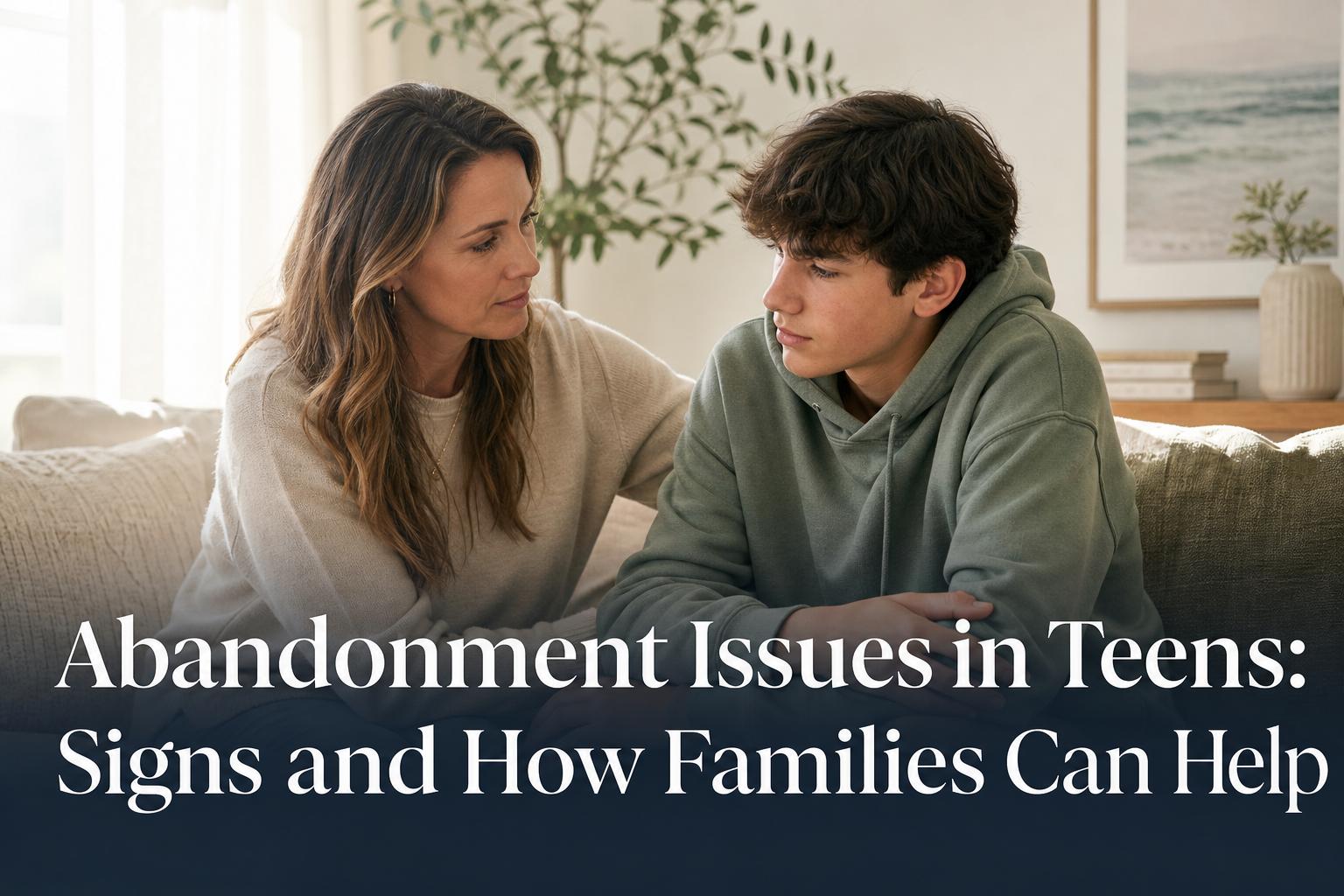
Abandonment issues aren't a formal diagnosis, but the fear behind them is real: a teen who has lived through loss, separation, or inconsistent care can come to expect people to leave. That fear often shows up as clinging, testing whether you'll stay, or pushing you away first so they're not the one left behind.
If your teen is in immediate danger, call 911. If they're thinking about suicide or self-harm, call or text 988 (Suicide & Crisis Lifeline). Mental Health For Teens does not provide emergency or crisis response.
What Abandonment Issues Mean in Teens
When clinicians hear a parent say "abandonment issues, " they usually look at two things: how the teen learned to attach to caregivers, and whether a loss or separation left the teen's nervous system on guard. The phrase is shorthand, and what sits underneath it differs from one teen to the next.
Attachment is the first piece. Teens build expectations about whether the adults in their lives will show up, stay calm, and come back. When a parent leaves, a home changes suddenly, or care has been unpredictable, a teen may decide that closeness isn't reliable. The National Child Traumatic Stress Network describes how traumatic loss and separation can affect a young person's sense of safety and trust in caregivers.
The second piece is a stress response. A teen who has been left, even once, may scan for signs it's happening again: a late pickup, an unanswered text, a parent's raised voice. The reaction can look out of proportion to the moment, but it makes sense given what the teen has lived through.
Teens also tend to show this differently than younger children do. A 7-year-old might cry at the door. A 15-year-old might text constantly, accuse you of not caring, or go silent for days, then act as if nothing is wrong.
Because "abandonment issues" isn't a clinical term, a diagnosis can only come from a clinician who looks at the full picture. That usually means asking about the teen's history, mood, sleep, school, friendships, and safety. Many teens with these patterns also have anxiety, depression, or trauma-related symptoms, and sorting out which is which shapes the kind of support that fits.
What Causes Fear of Being Left in Teens
Most often, the fear traces back to a specific loss or a pattern of unpredictability, not to anything the teen did wrong. Divorce, a parent's death, a parent leaving or being absent for long stretches, a move between households, or time in out-of-home care can each teach a teen that the people they depend on may not stay. The American Academy of Child and Adolescent Psychiatry offers family resources on how separation and loss affect children and teens, and its guidance is a reasonable starting point if you want to read further.
Inconsistency can hurt as much as a clean break. A parent who is warm one week and unreachable the next, promises that go unkept, or a caregiver whose mood is hard to predict can leave a teen unsure which version of the adult will show up. That uncertainty keeps the teen alert, and alertness is tiring.
Timing matters too. Adolescence is already a stretch when teens are pulling toward independence while still needing a secure base at home. A loss that happened years ago can resurface when a teen hits a new milestone, a parent starts dating, a step-parent moves in, or a friendship ends. If your teen's reactions seem to have grown louder lately, a recent change may have stirred up an old one.
Not every teen who goes through these events develops lasting fear, and you can't tell from the event alone who will. Temperament, other supportive adults, and how the loss was explained all play a part. A clinician will ask about all of it, along with whether the loss involved frightening or unsafe moments, because that shapes whether trauma-focused care fits. Our post on the childhood trauma test for teens covers what those questions look like.
Signs Parents See at Home
The pattern usually shows up in two opposite directions, and one teen can swing between both within the same week. Neither one is a diagnosis, and a clinician is the person who sorts out what's behind them.
Clinging looks like a teen who needs constant contact. They may text or call repeatedly when you're out, panic if you're ten minutes late, or ask the same reassurance questions again and again ("Are you mad at me?" "You're coming back, right?"). Some teens get distressed about sleepovers, a parent's work trips, or a step-parent's plans to go out for the evening.
Pushing away looks almost like the reverse. A teen may pick fights right before a separation, say "I don't care if you leave, " or end friendships and relationships before anyone can end them first. Testing is a close cousin: they act out or say something hurtful, then watch whether you stay. It can feel personal, but the behavior is usually checking whether closeness is safe.
Other signs show up in everyday moments:
- Intense reactions to small things, such as a canceled plan or a slow reply
- Jealousy or hurt when you give attention to a sibling, partner, or friend
- Difficulty trusting kind words, or assuming people are being nice out of obligation
- Stomachaches, trouble sleeping, or reluctance to go to school when separations loom
- Going quiet and withdrawn after a disappointment, then acting as though nothing happened
Notice when the reactions happen, how long they last, and whether they're getting stronger. Jot down a few specific examples with dates, since that gives a clinician something concrete to work from. If the reactions are interfering with school, friendships, or home life, our guide to signs your teen needs therapy can help you decide on next steps.
How Caregivers Can Rebuild Safety Day to Day
Predictability does most of the repair work, so start by making your comings and goings easy to anticipate. Tell your teen when you'll be back, then be back at that time, or text before you're late. A teen who expects to be left will notice every kept promise, and the small ones count as much as the big ones.
Say out loud what you're doing before you leave. "I'm at work until six, and I'll text you at three" gives a nervous teen something to hold onto. Keep the same goodbye and hello routines when you can, since repeated rituals tell the body that separation ends in a return.
When your teen tests you, respond to the worry underneath instead of the hurtful words. You might say, "I'm not going anywhere, and I still want to talk about this when you're ready." Set the limit on behavior calmly, but don't withdraw affection as the consequence. Silence or threats to leave, even in frustration, can confirm exactly what your teen fears.
Reassurance works better when it's steady and brief rather than long and emotional. If your teen asks the same question five times, answer it kindly each time, and over weeks you can gently move toward asking, "What do you think the answer is?"
Give your teen some control inside the routine. Let them choose which evening you eat together or how they'd like you to check in during a trip. Choices rebuild a sense that they have a say.
If a step-parent or another caregiver is involved, agree on the same approach so your teen isn't reading mixed signals. Parent coaching, which is built into care at Mental Health For Teens, can help adults practice these responses together. If daily reassurance isn't easing things after several weeks, that's a good reason to ask a clinician for an evaluation.
How Family Therapy Helps
Family therapy gives your teen and the adults they depend on a structured place to say what they've been afraid to say at home, with a clinician guiding the conversation so it doesn't turn into another fight. For a teen who fears being left, hearing a caregiver say "I'm staying" in a calm, supported setting can land differently than it does in the kitchen at 10 pm.
At Mental Health For Teens, family therapy is typically weekly when it's clinically appropriate, and it's built into both virtual IOP and outpatient care rather than billed as an add-on. Sessions happen by secure video, so you can join from home, and the teen needs a private space for the session. Teens also have confidential individual time with their therapist, so they don't have to choose between talking to you and talking to someone else. Safety limits on that confidentiality are explained up front, and you get plain-language progress updates.
In practice, a session often covers things like how a recent separation or change landed for your teen, what each of you does when the worry spikes, and how to respond differently. The clinician may coach you through the responses described above, such as answering reassurance questions steadily or setting limits without pulling away. The American Academy of Child and Adolescent Psychiatry points families to involvement in a young person's treatment as a recognized part of care for children and teens.
Expect it to feel awkward at first. Your teen may stay quiet, and you may hear things about your own part that are hard to take in. The clinician's job is to keep the room fair for everyone. You can read more about how this works on our family therapy for teens page.
When Trauma-Informed Treatment Is the Next Step
Trauma-informed treatment fits when your teen's fear of being left comes with signs of a stress response that home routines haven't eased: nightmares or flashbacks about a loss, jumpiness, avoiding anything that reminds them of the separation, or reactions that stay intense for weeks. A clinician makes any diagnosis, but those patterns are the ones that lead clinicians to look at trauma, including when the loss involved frightening or unsafe moments.
The National Child Traumatic Stress Network describes trauma-informed care as treatment that accounts for how past experiences shape a young person's current reactions, so the question shifts from "what's wrong with you?" to "what happened, and what does your body still expect?" Our page on trauma and PTSD treatment for teens explains how that looks in a teen's care, and the trauma therapy for teens page describes the approach in more detail.
Within our programs, trauma-informed care runs alongside CBT, DBT skills, and mindfulness. The clinical team looks at safety, daily functioning, and the support at home to decide between virtual IOP and outpatient care, and that level can change as your teen's needs change. More hours aren't automatically better, so a clinician recommends IOP only when that intensity fits.
Care is delivered by secure video, so your teen needs to be physically in California and have a private space at home. If a teen needs in-person or higher-level care, we refer your family to it rather than keep treating at home.
The first step is a free, confidential consultation with no obligation to enroll. A parent or legal guardian completes it. Have a few dated examples of your teen's reactions ready, along with any history of loss or separation you're comfortable sharing. You can start with the free assessment or call us at 619-354-3569, and start dates are set around your teen's school schedule.
Written by
Mental Health For Teens
Clinical TeamVirtual IOP and outpatient mental health programs for teens in San Diego and across California.