
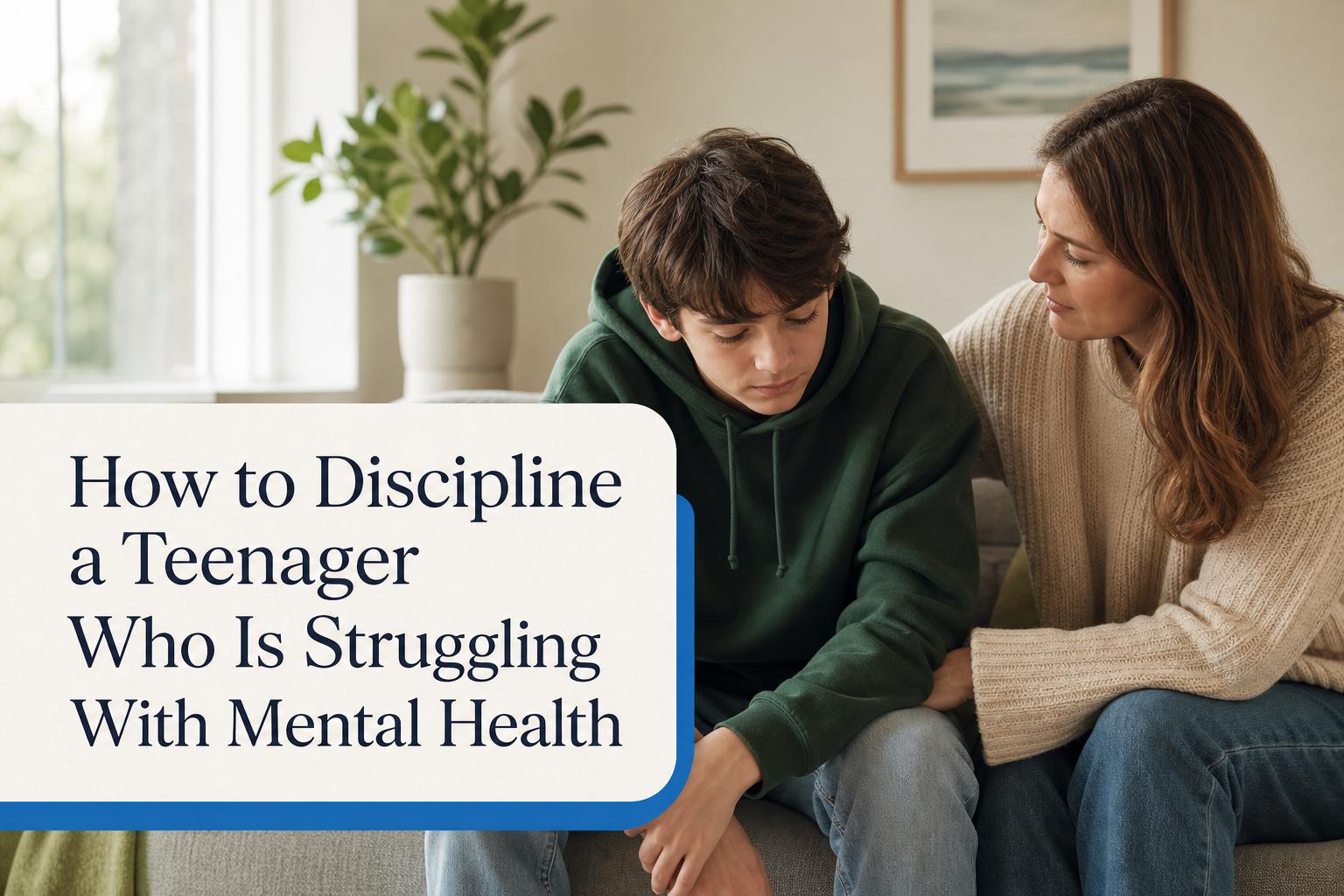
The best way to discipline a teenager who's struggling with anxiety, depression, or anger is to pair a calm, predictable limit with a clear acknowledgment of what they're feeling. Harsh punishment tends to raise the conflict level at home, which makes the underlying symptoms harder to treat. You don't have to choose between holding the line and easing up, because the two work together when you do them in the right order.
If you or someone you love is thinking about suicide or self-harm, call or text 988 any time, day or night. You can also chat with a trained crisis counselor at [988lifeline.org](https://988lifeline.org). If someone is in immediate danger, call 911 right away for emergency help.
How to Discipline a Teenager Who Has Anxiety, Depression, or Anger
Yes, you should still keep rules in place for a teen with anxiety, depression, or anger, because predictable expectations give a struggling teen something steady to lean on. What changes is how you enforce them. A teen with depression who sleeps through the morning and misses homework needs a different response than a teen who simply skipped it to hang out with friends, and the same goes for a teen with anxiety who refuses to go to practice.
Start by sorting each behavior into one of two groups. The first group is things a teen can do but chose not to, like ignoring a curfew or talking back. Those still get a clear, calm consequence. The second group is things a teen is struggling to do because of symptoms, like getting out of bed, finishing a big assignment, or leaving the house when panic hits. Those call for support and a smaller, doable expectation first, with a consequence only if the teen skips the smaller step you both agreed on.
You'll rarely get this sorting perfect, and that's fine. If you're unsure, ask your teen at a calm moment what made it hard, then listen without fixing. The American Academy of Pediatrics recommends discipline that teaches and keeps the relationship intact rather than relying on harsh punishment, and that matches how we coach parents.
Because we deliver parent coaching as part of care, parents practice these conversations with a clinician instead of guessing in the middle of an argument. If rules at home have turned into daily fights, our page on teen behavioral issues explains how we look at what's driving them.
Why Discipline and Punishment Work Differently
Discipline teaches a teen what to do next time, while punishment makes them pay for what already happened. That difference shows up fast in a teen with depression or anxiety, because a harsh penalty often lands as proof that they're a problem, and shame tends to deepen the symptoms you're trying to ease.
A useful test is to ask what the consequence is supposed to teach. If the answer is "to make you feel bad about it, " it's punishment. If the answer is "to practice a better choice, or to repair what got broken, " it's discipline. Taking the phone for a month after a missed curfew teaches little. Losing the phone overnight and planning the next curfew together teaches a specific skill, and your teen can see the end of it.
Good discipline has a few features you can check in the moment:
- 1It's connected to the behavior, so a late-night gaming problem leads to a change in gaming hours, not a lost weekend with friends.
- 2It's stated calmly, ideally after everyone has cooled down, not in the middle of yelling.
- 3It has an end point your teen knows in advance.
- 4It leaves room for repair, such as a conversation, an apology, or fixing the mistake.
Expect your teen to push back anyway. A limit delivered kindly can still get an eye roll or a slammed door, and that doesn't mean it failed. Hold the limit, skip the lecture, and come back to the feelings later.
If you can't tell whether a rule is reasonable for your teen's current symptoms, that's a good question for a clinician. In family sessions we help parents sort out which expectations to keep and which to adjust, and our family therapy page explains how those sessions work.
How Validation and Limits Work Together in Parent Coaching
Validation tells your teen their feeling makes sense, and the limit tells them what the behavior will cost, so you say both in the same conversation. A parent might say, "I can see you're dreading tomorrow, and you're still not staying home from the game, so let's figure out what would make the ride easier." The first half doesn't weaken the second.
Validation isn't agreement. You can say "it makes sense you're furious about losing your phone tonight" and still keep the phone in the kitchen. Teens with anger or low mood often escalate because they feel unheard, so naming the feeling first usually lowers the temperature enough for the limit to land.
In parent coaching, which is built into both our virtual IOP and outpatient care, the clinical team walks through this sequence with you and helps you practice it before the next hard moment:
- 1Pause until you're calm enough to speak slowly.
- 2Name the feeling in one sentence, without a "but" attached.
- 3State the limit and the consequence in plain words.
- 4Offer one choice your teen controls, like when the consequence starts.
- 5Stop talking and let the limit stand.
Coaching also covers what to do when it doesn't go well. If your teen storms off, you don't chase them or add penalties. You follow through later and check in once everyone has settled.
Because our teens use CBT and DBT skills in their own sessions, parents learn the same language, so a reminder at home like "try the skill we practiced" sounds familiar instead of like a lecture. Parents get plain-language progress updates, which helps you see whether the limits you're setting fit what your teen can handle right now.
Consequences That Keep Structure Without Escalating Conflict
The consequences that hold up best with a struggling teen are small, tied to the behavior, and over within a day or two. Losing phone access from 9 pm until morning after a night of staying up past the agreed time works better than a week without the phone, because your teen can still succeed tomorrow and you'll have a reason to notice it.
A few examples show how this plays out. If your teen skips homework because of low energy, the consequence might be a 20-minute work block before any screens, with you sitting nearby. If your teen yells at a sibling, the consequence is repair: an apology and taking over that sibling's chore for the evening. If your teen breaks curfew, the next night's curfew moves earlier, and the original time comes back after one on-time night. Each one has an end point your teen can see, and each one asks for a skill rather than suffering.
Choose consequences you can enforce without a fight. If you'd have to physically take something or stand guard for hours, pick a different one. A limit you can't follow through on teaches your teen that rules bend under pressure, and that makes the next argument longer.
Skip consequences that remove the things helping your teen cope, such as therapy sessions, sleep, meals, medication, or time with a trusted friend. Those aren't privileges, and taking them away tends to worsen symptoms. Our individual therapy is built into care, so your teen's sessions stay on the calendar no matter what happened at home.
When a consequence seems to make things worse for several days in a row, bring it to your teen's clinician. Adjusting it with their guidance is part of how coaching works, not a sign you backed down.
Responses That Make a Struggling Teen's Behavior Worse
Yelling, sarcasm, and threats you won't carry out tend to push a teen with anxiety, depression, or anger further into withdrawal or outbursts, because they add shame and fear to symptoms that already feel heavy. Raised voices also shut down the part of a teen's thinking you're trying to reach, so the lesson you wanted to teach rarely gets heard.
Three other responses cause trouble more quietly. The first is stacking penalties, where a teen who's already lost the phone also loses the weekend and the team. Each new loss feels pointless once the first one has done its work, and a teen with low mood can read it as proof that nothing they do matters. The second is reopening an argument after the consequence has been served. Once the phone is back, the issue is closed, and bringing it up again turns a finished limit into an ongoing punishment.
The third is comparing your teen to a sibling or to how you handled things at their age. Teens with depression or social anxiety often already believe they're falling short, so comparisons confirm the worst story they tell themselves.
Parents also change the rules mid-conflict, usually out of exhaustion. That's understandable, but a limit that shifts with your mood teaches your teen to escalate until it moves. If you realize a consequence was too big, say so later when things are calm, and set a smaller one together.
If you notice yourself reaching for these responses every day, that's useful information, not a failure. It usually means the household needs more support than rules can supply, and our parent coaching work exists for exactly that situation.
Signs Behavior Needs More Than Rules at Home
Behavior needs more than rules at home when it keeps getting worse despite calm, consistent limits, or when it starts to cut into sleep, school, friendships, or safety. A few weeks of steady structure with no change is a reasonable point to ask a clinician what's driving it. Withdrawal that deepens, panic that keeps your teen out of school, rage that ends in broken property or hurting others, and any mention of self-harm all belong with a professional, not a stricter consequence. A clinician makes any diagnosis, and a diagnosis doesn't decide the level of care. The clinical team weighs safety, daily functioning, and how much support your family has.
If you reach out to us, the first step is a free, confidential consultation with no obligation to enroll. A parent or legal guardian completes it. Have a few notes ready on what you're seeing, how long it's been going on, and what you've already tried at home. The team also screens for safety and home environment, and if home-based care isn't the right fit, they'll point you to in-person or higher levels of care.
Care is delivered by secure video, and your teen needs to be in California with a private space at home for sessions. Virtual IOP typically runs about 9 to 12 clinical hours a week, and outpatient is lighter, at one to three sessions a week, both in the evening after school. Family therapy and parent coaching are part of both. Our team doesn't provide emergency or crisis response, so if safety is the concern, use the numbers at the top of this page first.
To talk through which level fits, call us at 619-354-3569 or book a free consultation. Benefits vary by plan, and we verify your insurance before enrollment.
Written by
Mental Health For Teens
Clinical TeamVirtual IOP and outpatient mental health programs for teens in San Diego and across California.