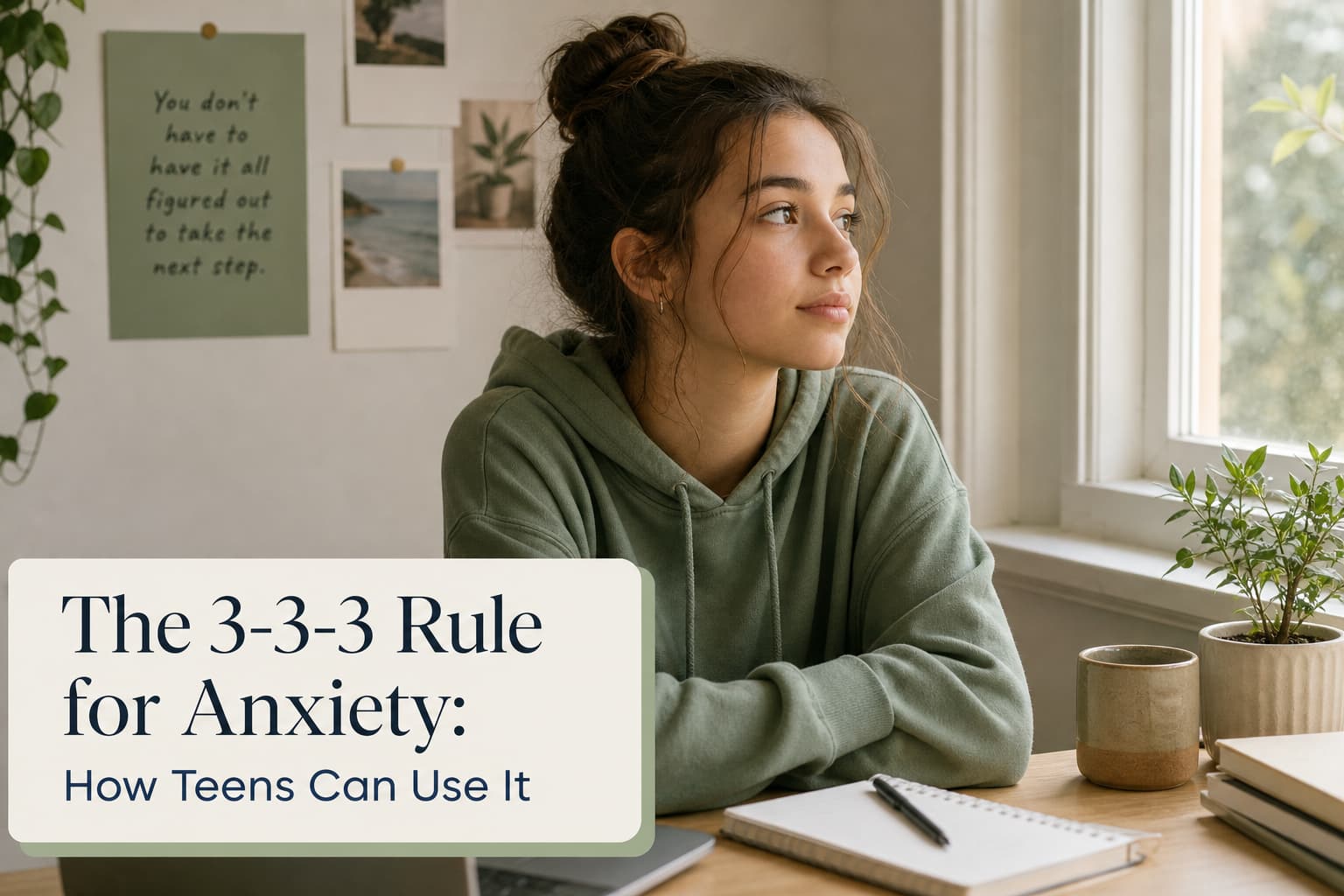


In DBT for teens IOP, your teen practices specific coping skills in clinician-moderated video groups on Tuesday, Wednesday, and Thursday evenings, then uses them at home that same week. Most of the work is learning what to do in the moment an urge, panic, or flashback hits, and rehearsing it until it's usable. Sessions happen after school, from your home, with individual and family therapy built in.
If your teen is in immediate danger, call 911, or call or text 988 (Suicide & Crisis Lifeline).
What Does DBT for Teens IOP Look Like in Virtual Groups?
A typical evening starts with your teen logging in from a private spot at home, usually their bedroom or a quiet corner, at one of the 5pm, 6pm, or 7pm PT slots. We assign the exact time with your family at intake, so it can fit around practice, homework, and dinner.
Groups are led by a clinician who moderates the conversation, teaches one skill, and walks the teens through using it on a real situation from their week. Teens aren't asked to perform or to tell their whole story. They can share as much as they're ready to, and the clinician keeps the group focused on what to do next time, not on reliving what went wrong.
Group is one piece of roughly 9 to 12 clinical hours a week. The rest is individual and family therapy, plus psychiatric consultation when a clinician thinks it's needed. Your teen also reviews a diary card, a short daily log of emotions, urges, and which skills they tried, which gives the group and their therapist something concrete to work from.
For the video to work well, your teen needs a private, secure place to talk and a stable connection. Headphones help a lot, since teens speak more openly when siblings and parents can't overhear. You'll want to stay out of earshot during group, even when you're curious how it's going. Your own part comes in the family sessions.
Which DBT Skills Do Teens Practice Each Week?
Teens work through the four standard DBT skill areas in group: mindfulness, distress tolerance, emotion regulation, and interpersonal effectiveness. Each evening, the clinician picks one skill from those areas and spends most of the hour on practice rather than explanation.
Mindfulness comes first because the other skills depend on it. Teens practice noticing a feeling, a body sensation, or an urge without acting on it right away. That pause is what makes the next skill possible.
Distress tolerance is the set of skills for getting through a spike when the problem can't be solved that night. Examples include changing body temperature with cold water, paced breathing, and intense exercise. Teens also practice distracting themselves on purpose and soothing themselves with their senses. These are the skills your teen is most likely to reach for in a hard moment, so groups rehearse them until they feel automatic.
Emotion regulation covers understanding what a feeling is doing, building routines for sleep and eating that steady mood, and acting opposite to an urge, such as reaching out to a friend when the pull is to withdraw.
Interpersonal effectiveness is the practice of asking for what they need, saying no, and repairing a rough conversation without exploding or shutting down. Teens often rehearse real scripts for a parent, a teacher, or a friend.
You don't need to memorize the names. What helps at home is asking, "Which skill did you work on tonight?" and then letting your teen answer in their own way. Many teens will show you a skill by using it, so notice when they take a breath before replying or step away to cool down. A short, warm comment like "I saw you take that break" tells them the effort is visible.
How DBT Skills Apply to Self-Harm Urges and Trauma Reactions
Urges to self-harm tend to peak and pass, and DBT teaches teens to get through the peak without acting on it. In group, a clinician helps teens map what usually comes before an urge, such as a fight, a rejection, or a flood of shame. Then they pick distress tolerance skills to try at each point. A teen might hold ice, do paced breathing, or move hard for a few minutes, then rate the urge again to see whether it dropped. That rating habit matters, because it gives your teen proof from their own experience that the urge doesn't last.
Trauma reactions get similar treatment. When a flashback or sudden panic hits, mindfulness and grounding skills help a teen come back to the present: naming what they see in the room, feeling their feet on the floor, slowing their breath. Groups practice these skills while everyone is calm, so they're familiar when things aren't. Teens aren't pushed to describe what happened to them. The skill work is about managing the reaction now.
What you'll see at home may be small. Your teen might mention a diary card entry about an urge, or ask for a few minutes alone to use a skill. Respond with calm and without interrogating. Asking "Do you want company or space?" is usually better than asking for details.
Self-harm and trauma symptoms are also reviewed in individual sessions, where your teen's therapist can go deeper than group allows. In family sessions, you'll learn how to respond when your teen is struggling, including what to say and what to leave alone. If an urge ever feels like more than your teen can manage at home, tell the care team right away so they can adjust the plan.
How Diary Cards, Individual Sessions, and Family Work Fit Together
The diary card is the thread that connects all three parts of IOP. Your teen fills it out daily, and the group clinician reviews it during DBT skills groups. Their individual therapist uses the same card to pick what to work on in one-on-one time. Nobody has to start from scratch each week, and your teen doesn't have to re-explain a rough Tuesday three separate times.
Individual sessions are where the card gets read closely. If it shows a skill your teen keeps skipping, or an urge that shows up at the same hour every day, the therapist can ask about it directly and adjust the plan. Those patterns are hard to see from inside a group of several teens, so the individual hour often fills in what group can't.
Family sessions take what the therapist and teen have learned and put it to use at home. You'll hear which skills your teen is practicing and how you can respond when they use one. You'll also have room to bring your own questions about what you're seeing. Family sessions are a working conversation, not a report card on your parenting.
Your teen's privacy matters here. The diary card is theirs, and most teens share more when they trust it won't be turned into a checklist at the dinner table. Ask the care team what gets shared with you and when, so you and your teen both know the ground rules before anything is written down.
As your teen's symptoms ease and the level of care steps down to outpatient, the same therapist often stays with them. Step-down groups are available as the intensity decreases, so the skills your teen has built keep getting practiced instead of dropping off all at once.
Signs Your Teen May Need IOP Instead of Weekly Therapy
Weekly therapy is the right level of care for many teens, so the signs worth watching are the ones that show one hour a week isn't holding. The clearest is a skill gap. Your teen understands the coping skills in session but can't use them between appointments, and the hard moments keep landing on evenings and weekends when no clinician is there.
Other signs tend to cluster together:
- Self-harm urges or acts keep happening despite several weeks of regular therapy.
- Panic, flashbacks, or emotional blowups are frequent enough that home life revolves around them.
- School attendance, sleep, or friendships are slipping, but your teen can still get through most days at home.
- Family conflict flares up often, and you don't know how to respond when your teen is in distress.
- Your teen has stepped up from outpatient before, or symptoms are getting worse instead of holding steady.
If several of these sound familiar, ask for a consultation rather than waiting for another month of weekly sessions to show whether anything changes. More hours aren't automatically better, though. A clinician recommends IOP only when that intensity fits your teen's symptoms and the structure they need, and many teens do well with outpatient care and one to three evening sessions.
The consultation is free and confidential, and the level of care can change later in either direction. If IOP turns out to be more than your teen needs, outpatient is the match. If outpatient starts to feel too light, the team can step your teen up.
Your teen's own view counts too. A teen who says "I know what to do, I just can't do it when it's bad" is describing exactly the gap that group practice and daily diary cards are built to close.
What Happens When You Call and Who Virtual IOP Isn't Right For
When you call 619-354-3569, an admissions team member asks about your teen's age, where they live, what symptoms you're seeing, and what weekly therapy has or hasn't covered. Have a rough timeline of the past few weeks ready, along with any current providers and medications. If you plan to use insurance, we verify it before enrollment, so keep your card nearby.
The consultation is free and confidential. Your teen must be 12 to 17 and physically in California during sessions. If it's a fit, we match your teen to virtual IOP or outpatient, assign evening time slots at intake, and most families start within a few days.
Virtual care isn't the right setting for every teen. Our clinical approach flags three situations where something more is needed:
- Active suicidal crisis without a safety plan.
- Psychosis that requires in-person evaluation.
- Severe substance use needing a higher level of medical care.
We don't provide inpatient, partial hospitalization, residential, or emergency services, and we don't see teens in person. Your teen also needs a private, secure spot at home and the ability to take part safely from there. If a higher level of care is the better answer, we'll say so plainly and coordinate with local providers rather than leave you to sort it out alone.
Two other things to ask admissions about up front: we don't offer standalone ADHD prescribing or diagnostic evaluations, and enrollment doesn't automatically create a 504 plan or IEP. Asking early saves you a surprise later.
If your teen's coping skills aren't holding between weekly appointments, call 619-354-3569 or book a free consultation at mentalhealthforteens.com.
Written by
Mental Health For Teens
Clinical TeamVirtual IOP and outpatient mental health programs for teens in San Diego and across California.